

Monte Tarbox
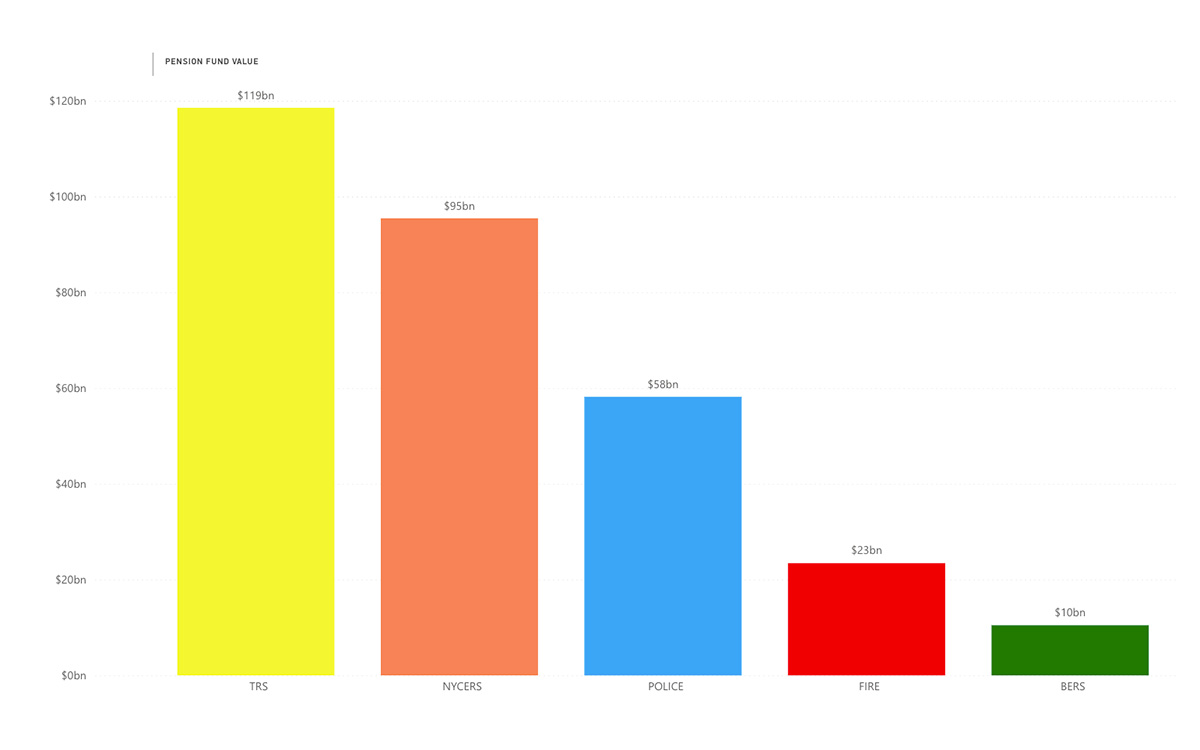
Few pension funds are as complex as New York City’s. The city’s five funds—the Teachers’ Retirement System of the City of New York, the New York City Employees’ Retirement System, the New York City Police Pension Fund, the New York City Fire Pension Fund and the New York City Board of Education Retirement System—collectively managed $306.18 billion in assets as of March 31. Each of the funds uses numerous consultants and has its own board of trustees.
The pension system reported annualized returns of 10.3%, 9.4% and 8.5% over the prior one, three and five years, respectively. In total, the five funds ensure the retirement security of more than 750,000 beneficiaries.
In an interview with CIO, Tarbox discussed his experience as an investor on behalf of Taft-Hartley plans, his initiatives for the New York City funds, the role of a fiduciary, and how the city’s pension system is looking to invest and engage with its portfolio companies.
Pension Fund Value (as of March 31)
Source: NYC Bureau of Asset Management
In June 2023, Tarbox retired from his 10-year tenure as executive director of investments at the National Electrical Benefit Fund in Washington, D.C. Before that, he was CIO of the International Association of Machinists National Pension Fund and held several roles as an investment consultant serving pension funds across the U.S.
He was named interim CIO for the New York City pensions in January, following the departure of former CIO Steven Meier to a new role at Neuberger.
“I had been delightfully retired for two years, when in October [2025], I got a call from one of the staff in [then-]Comptroller Brad Lander’s office saying that they needed somebody to step in on an interim basis and help with the transition from one administration to the next, and would I consider it?” Tarbox says. “I thought about it, talked to my wife and agreed that, yeah, it sounded like a good way to engage in some public service and spend some time in New York, a place I love.”
Tarbox became the pension systems’ permanent CIO at the end of March. One pension academic noted that it was not surprising that the system’s next CIO would come from a Taft-Hartley background, due to the strong labor focus of Mayor Zohran Mamdani’s new administration and the sizeable union employment in the city.
Fiduciary Duty
Tarbox’s background as a union pension investor has informed his view of what fiduciary duty is, not just ensuring strong returns for retirees, but ensuring that pension money is invested for the benefit of workers and communities.
“I take an expansive view toward fiduciary duty. Most of my trustees in past jobs always took the position that they care very much about making money, but [care] equally about how the returns get made, and where does the economic value come from?” Tarbox says. “Are we actually building real things, or is this just financial engineering? They were particularly concerned about how workers got treated [by] the portfolio companies within which we invested.”
Tarbox notes that the goals of achieving a good risk-adjusted investment return and making a positive impact are inextricably linked.
“I would take it a step further, in fact: I would say that respecting the environment and treating workers with respect … is a high-road business model that leads to good financial returns,” Tarbox says. “Cutting corners, taking advantage of people, not paying attention to health and safety, not paying attention to pollution may look like short-term gains, but in the long [run], it’s not a sustainable strategy.”
Unlike many corporate pension funds, which are investing to meet the liabilities of closed and frozen pension funds, public funds are different. Tarbox notes that the city’s pension funds are making investments today that need to grow value over generations and that taking a long view aligns well with being concerned about the impacts of the systems’ investments.
“One of my goals is, with our team, to remind them that it’s not our money,” Tarbox says. “Frankly, it’s not even the trustees’ money; it’s the money that belongs to the beneficiaries and participants of the plan. … Everything we do, we should keep in mind a picture of a retiree who is counting on the pension fund to make sure that they get their pension check on time and exactly in the amount they were expecting. If we do that, then [we’ve] satisfied not just our fiduciary duty, but our moral obligation, to the participants.”
Affordable Housing and Private Markets
Among the priorities of Mark Levine, the city’s new comptroller who took office earlier this year while Tarbox was still the interim CIO, is to more than double the pension systems’ investments in affordable housing. That initiative, formally announced in April, aims to invest more than $4 billion over the next four years into affordable housing projects across the city’s five boroughs.
These kinds of investments include financing the construction of new housing, preserving affordable housing that already exists and supporting the conversion of offices to residential units.
“I’m very excited about that, because I think it’s eminently doable,” Tarbox says. “Some people ask us why we’re doing it now, and I think that recent events [have] reminded everybody about the affordability crisis, particularly in housing, and notably in New York City.”
Average rent in the city is $3,606 per month as of May 12, according to data from Zillow, up $105 from one year earlier. Increasing housing supply is core to improving affordability. The comptroller’s office is not new to such investments—it has deployed $2.8 billion to “economically targeted investments” since the program’s inception in 2002, and it has a 2% portfolio policy allocation to affordable housing. Currently, only 1% of the portfolio is invested in economically targeted investments.
“The time is right,” Tarbox says. “We are taking several investment strategies that we have engaged with for over a decade, and we’re scaling them up. So we’re taking things that we know work, and we’re going to try to make them better.”
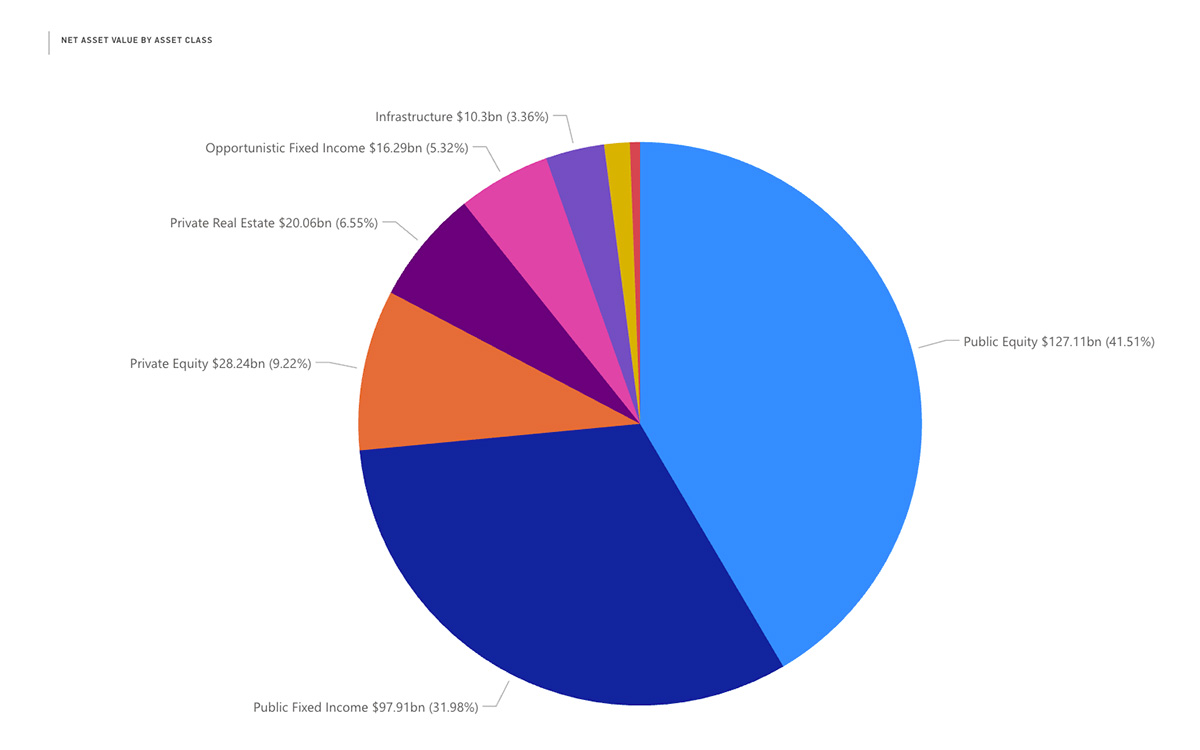
Additionally, Tarbox highlighted the growing importance of alternative investments, such as private equity and private credit, in an institutional portfolio. Across the city’s five funds, nearly $80 billion is invested in alternative strategies, including private equity, private real estate, opportunistic fixed income, infrastructure and hedge funds.
Net Asset Value by Asset Class (as of March 31)
Source: NYC Bureau of Asset Management
These investments are essential, Tarbox says, especially as the number of public companies has dropped over time, while the number and value of private companies continue to grow.
“In order to be fully diversified across all vectors of economic activity in the United States, you have to have a big slug of publicly traded equities, but you also have to be investing in private equity,” Tarbox says. “There’s no way to index that or no way to buy the market portfolio anymore because there’s so many moving parts, but I think it’s just essential that pension funds consider private equity.”
Private credit is an extension of the same logic, he adds.
“I’d be tempted to argue that pension funds have an obligation to consider private credit, if they see both good returns and contributing to healthy growth of our economy to be a part of their mission,” Tarbox says.
Tarbox’s philosophy is that by ensuring strong returns for retirees, pension funds are also invested for the benefit of workers and communities. To accomplish that, they need to invest broadly.
“We’re universal investors, we’re going to be in capital markets and in stocks and bonds for generations, and what I want to do as a pension fund investor is basically put a bet on the U.S. economy,” Tarbox says. “I’m concerned about the individual components … and the individual companies, but I want broad diversification so that our portfolio can prosper with the growth of the U.S. economy, and private lending is playing as big a role as I think it has in my entire career, and we’d be well advised to take that seriously and try to participate in a responsible way.”
Embracing an Active Role via DEI, ESG Considerations
New York City’s pension system has long been an engaged, activist investor, even as recent federal efforts have aimed to curtail the power of such shareholder proxy initiatives President Donald Trump issued an executive order in December 2025 based on “protecting investors from politicized advice” from proxy advisers Glass, Lewis & Co. LLC and Institutional Shareholder Services Inc. The latter is, like CIO, owned by ISS STOXX. The Department of Labor clarified in an April technical release that proxy advisers “regularly fit the definition of functional fiduciaries” and that the actions of managers, sovereign funds and others could also make them advice fiduciaries.
“I will say I am profoundly disappointed that we find ourselves in an era where some of these advances are being rolled back by regulators, the courts, federal initiatives and corporate America, for that matter, because I think over the course of the last 30 years, we’ve benefited greatly from shareholder engagement in corporate governance,” Tarbox says. “It’s held many companies accountable and raises the standards for how we expect corporate executives not only to fulfill their responsibilities to their shareholders, but also to their workers and the communities in which they operate.”
That sense of backsliding, he says, is not limited to corporate governance alone.
“I’m also disappointed about the backwards steps being taken by many on diversity and inclusion, because in our portfolio, we think that the record has been clear and unambiguous that the use of diverse and emerging managers has led to better investment returns,” Tarbox says.
Tarbox said the pension systems’ diverse and emerging manager program has outperformed comparable parts of the portfolio. According to a report from the comptroller’s office, private market assets managed by minority- and women-owned business enterprises outperformed benchmarks with an average public market equivalent spread of 7%.
“I take very seriously our responsibilities as capital allocators and as the stewards of pension fund money around those issues,” Tarbox says. “Both in the case of diversity and [environmental, social and governance principles], there may be temporary setbacks, but the momentum is strong, the need is strong, and particularly with respect to the environment, the crisis is not going to go away if we don’t deal with it intentionally and look for long-term solutions.”
 |
Monte Tarbox Named Permanent CIO of $316B NYC Retirement System |
 |
Monte Tarbox Named Interim CIO of NYC Pension System |
 |
Mark Levine’s Priorities at the NYC Pension System |
Tags: Mark Levine, Monte Tarbox, New York City Bureau of Asset Management, New York City Comptroller’s Office, New York City Employees' Retirement System (NYCERS), NYC