


Over the past 15 years, U.S. corporate pension funds have achieved a stunning turnaround. The 100 largest corporate pension plans by assets reached 104% funded status in 2025, a dramatic improvement from the deep deficits that plagued the industry following the global financial crisis of 2008 and 2009. As of the end of 2025, 60% of these plans were overfunded and had a combined surplus exceeding $86 billion—up from just 8% a decade ago, when their surplus totaled $7 billion.
This transformation reflects more than just favorable market conditions. Nearly every large corporate plan has outperformed its liabilities over the past decade, generating 230 basis points of annualized surplus returns. The persistent outperformance demonstrates that thoughtful asset allocation and disciplined risk management—not luck—are driving long-term success and creating stores of surplus value in plans’ reserves. These surpluses are not fleeting, and we expect them to be sustained and grow over time, supported both by more resilient portfolios and the structural advantages of being overfunded. Benefit payments naturally boost funded status, and the leverage effect of holding more assets than liabilities means surplus returns translate into larger funded status gains than they would for an underfunded plan.

From left: Michael Buchenholz, Jared Gross, Joseph Steccato.
Corporate pension funds now have durable surpluses that they can deploy to support existing benefit accruals, design new benefits, pay for retiree medical benefits, and facilitate workforce transitions through early retirement programs. Yet one of the most powerful use cases—funding defined contribution plan retirement benefits such as 401(k) matches directly from surplus—remains largely prohibited under current law. This limitation, which does not exist in many non-U.S. jurisdictions, is one the pension community is working with Congress to address.
The legal framework governing surplus use in the U.S. was built for a world in which defined benefit pension funds were chronically underfunded. That world no longer exists. Today’s corporate environment—characterized by sustained DB plan surpluses and nearly 90% DC participation where plans are offered—would benefit from new rules that allow sponsors to align retirement policy more closely across both DB and DC plans.
60% of U.S. Corporate Pensions Contribute to an $86B Aggregate Surplus
An improvement from 8% and $7 billion a decade ago
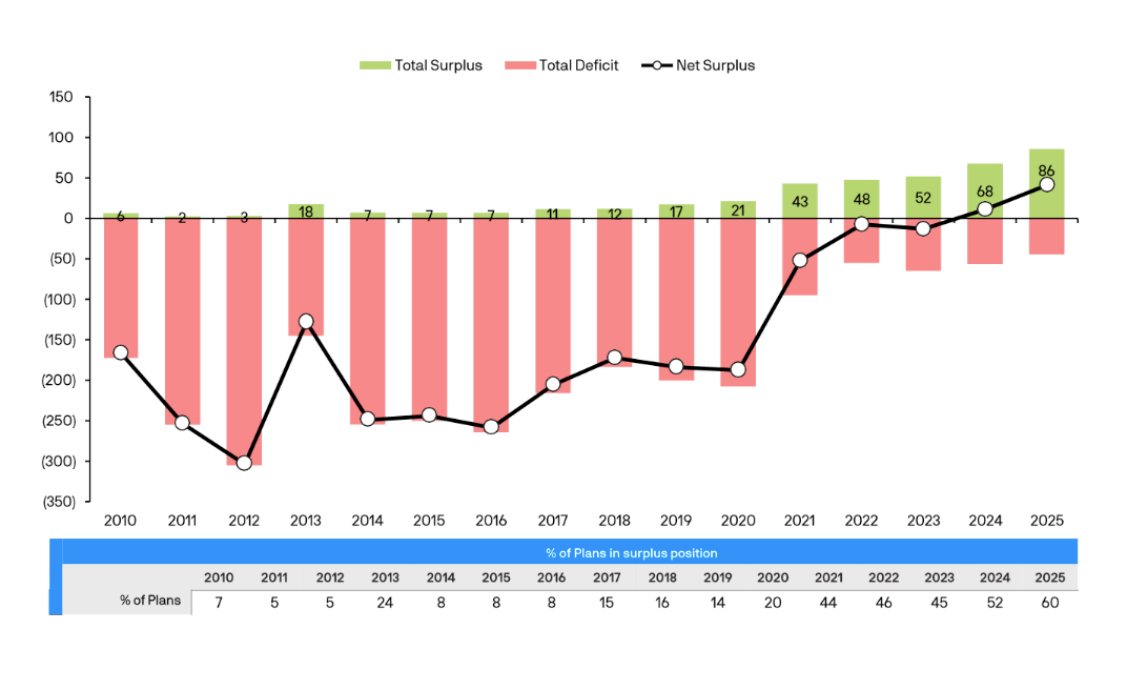
Source: Company 10-K filings, J.P. Morgan Asset Management; data as of December 31, 2025. Numbers may not add up due to rounding.
Here, we take a closer look at how the industry is embracing surplus innovation, developing new use cases and advocating for more regulatory flexibility to support retirement security across the pension ecosystem.
Value Creation Aligns With Corporate Finance
Throughout the previous decade, persistent deficits meant that CIOs were almost solely responsible for pension value creation, which largely required generating returns above their plans’ liability growth to close any deficits and minimize sponsor cash contributions. With more pension funds in surplus than deficit in 2026, pension value creation depends more directly on sponsors’ ability to monetize and deploy a surplus as it accumulates.
Value creation is now a joint effort between the CIO, chief financial officer or treasurer, and human resources or benefits leadership. Rather than focusing on “getting out of the pension business,” as conventional wisdom once demanded, corporate leaders are now collaborating on new applications for pension surplus, treating it as a strategic balance sheet asset that can fund a range of employee benefits. Based on our analysis of recent corporate actions, we have ranked surplus deployment options in approximate order of valuation, though priorities vary based on each sponsor’s strategic objectives and financial position.
The List of Positive Use Cases for Surplus Funding is Growing
Some uses are finite and can be valued precisely, others are unconstrained and harder to value.
| Highest Value Use Case | |
| Existing accruals | Fund current benefit accruals with surplus rather than cash contributions. |
| New accruals | Increase benefit levels or reopen closed plans to new participants. |
| Proposed: DC funding (401[p]) | Fund DC contributions (including 401[k] matches) from surplus without plan termination (requires legislative authorization). |
| Administrative costs | Pay ongoing plan expenses (e.g., PBGC premiums, administrative fees, staff costs). |
| Moderate to High Value/ Situational Use Case | |
| Retiree medical (Section 420) | Transfer excess assets into a 401(h) account for retiree health or life insurance benefits. |
| M&A currency | Use surplus to fund deficits in an acquired company’s underfunded plan. |
| Capital buffer | Support higher-return investment strategy to generate additional surplus while maintaining low required contribution risk. |
| DC-to-DB rollover | Enable employees to roll DC balances into DB plan annuities (per Revenue Ruling 2012-4). |
| Workforce management | Support strategic workforce initiatives through pension-funded incentives (lump sums, early retirement windows, subsidized benefits). |
| Termination: qualified replacement plan | www |
| Lowest Value Use Case | |
| Termination: pure reversion | Revert surplus to the sponsor’s balance sheet subject to 50% excise tax. |
| Hibernate | Amortize surplus over time to fund underperformance of minimum-risk investment portfolio vs. liability. |
Source: J.P. Morgan Asset Management. For illustrative purposes.
With New Use Cases, Opportunities Emerge
As sponsors strategize ways to deploy their surplus, the corporate pension community has coalesced around a legislative provision first introduced in the Strengthening Benefit Plans Act of 2025, Senate bill 2003, which was referred to the Senate Committee on Finance in June 2025. The provision, which would create a new section 401(p) of the Internal Revenue Code, represents an important step toward modernizing the rules governing surplus use. At its core, it would permit employers to transfer surplus assets from a DB pension plan to help fund DC benefits without terminating the DB plan. That said, the proposal could be stronger if it expressly permitted funding for core DC benefits, such as 401(k) matches, instead of only nonelective contributions, and also established realistic guardrails to protect participants and encourage sponsors to maintain ongoing DB plan sponsorship.
The legislative changes could allow the corporate pension community to use the surplus in innovative ways, providing several real benefits to the pension ecosystem:
Enhanced retiree and participant security: A 401(p) framework would advance the priorities that matter most to retirees and participants: protecting lifetime income, supporting stronger plan funding, and helping workers maintain steadier retirement contributions over time. With realistic guardrails, it could strengthen retirement security in a more durable way.
Added flexibility regarding the deployment of surpluses might incentivize employers to keep DB plans open and pre-fund them above minimum requirements if they knew a portion of any true surplus could be used prudently to support other retirement benefits, including 401(k) matches. Participants might also be less likely to experience an employer contribution “holiday” in the DC plan (such as those that occurred during the COVID-19 pandemic and are arising again as some companies work to fund transitions to higher-technology usage).
Moreover, the Pension Benefit Guaranty Corporation , which backstops DB plan benefits, might also reap an
indirect benefit. With a $60 billion surplus pool rivaling that of the combined 100 largest corporate sponsors, the single-employer PBGC insurance program is in good health. The proposed change should not jeopardize the PBGC’s position for two reasons:
- The proposed legislation would create a buffer by requiring DB plans to remain at least 110% funded on a PBGC basis; only surpluses above that level would be eligible for transfer to DC plans; and
- The bill would incentivize sponsors of overfunded DB plans to remain in the PBGC’s insurance pool, rather than terminate the plan and exit. This could potentially strengthen the PBGC over the long term.
Higher government revenue: Employer contributions to 401(k) plans are generally tax deductible. Under the proposal, transfers to DC plans from DB surplus would receive no deduction. The net effect—if surplus transfers replaced
traditional deductible employer contributions—would be an increase in corporate taxes paid, if all else remained equal.
wGreater sponsor flexibility: The ability to fund DC contributions from DB surplus could unlock stranded pension value, improve cash-flow efficiency and give sponsors a more effective path to monetizing a recurring surplus.
Putting the ‘I’ Back in CIO
In the post-GFC era, many pension fund CIOs focused intensely on risk management and hedging; generating investment returns almost became an afterthought. Corporate executives took the view that, in regard to their DB pensions, no news was good news. As plans have entered surplus, however, attitudes about pension investing and the strategic value of surpluses have shifted.
The possibility of permitting plan sponsors to make DC plan contributions from DB surplus would further transform the roles of many pension CIOs, because surplus DB assets could be thought of as quasi-endowment or long-term operating pools. Many CIOs already manage surplus assets with endowment‑like discipline and have the operational infrastructure to support DB‑to‑DC transfers—only the statutory authority is missing. Of course, ensuring sufficient liquidity for desired DC transfers and setting risk tolerances to meet the plan sponsor’s objectives and constraints would require coordination across all stakeholders.
From Theory to Investment Practice
Today’s pension surpluses represent a strategic asset with tangible value, deployment options for which could expand significantly under proposed legislation. The proposed 401(p) framework to allow DB‑to‑DC transfers might be the logical next step—and one that could potentially deliver measurable benefits to retirees, participants, employers and the federal government. With DB plans healthier than they have been in years, policymakers have a powerful opportunity to unlock the accumulated value for the next generation.
Michael Buchenholz is the head of U.S. pension strategy in J.P. Morgan Asset Management’s institutional solutions strategy and analytics team.
Jared Gross is the head of institutional portfolio strategy, responsible for providing insights and solutions to institutional clients, including corporate and public pensions, endowments, foundations and healthcare institutions.
Joseph Steccato is a client adviser and the North American institutional corporate pension client segment head.
This feature is to provide general information only, does not constitute legal or tax advice, and cannot be used or substituted for legal or tax advice. Any opinions of the author do not necessarily reflect the stance of ISS STOXX or its affiliates.
Tags: Corporate pension funding, Defined benefit, Defined Contribution, surpluses