


New York City’s $1.97 billion rainy day fund and another backstop account need to be nearly doubled to 16% of annual tax revenue from a current value of 8.5% to act as a “fiscal shock absorber” for the risks posed by artificial intelligence, City Comptroller Mark Levine said.
New York City’s Revenue Stabilization Fund was created in 2019 to stash away money to help financially support the city during economic downturns. Combined with the Retiree Health Benefit Trust, “routinely identified by the mayor as a ‘reserve’ and … used as a de facto rainy day fund,” the accounts hold $7.2 billion according to Levine’s proposal. Reaching 16% of annual tax revenue would mean $13.55 billion between the two funds based on fiscal 2026 figures.
“We need to ensure our pension system is robust to potential AI-driven market turbulence,” Levine said in a statement. “Our pension funds, approaching a third of a trillion dollars in assets, are invested across every level of the AI economic stack. In a city of extraordinary wealth where 2 million people live in poverty, AI could either help narrow inequality—or deepen it further.”
According to the comptroller’s office, the target is based on the city’s historical experience in economic downturns, during which total revenue losses tumbled 16% before fully recovering.
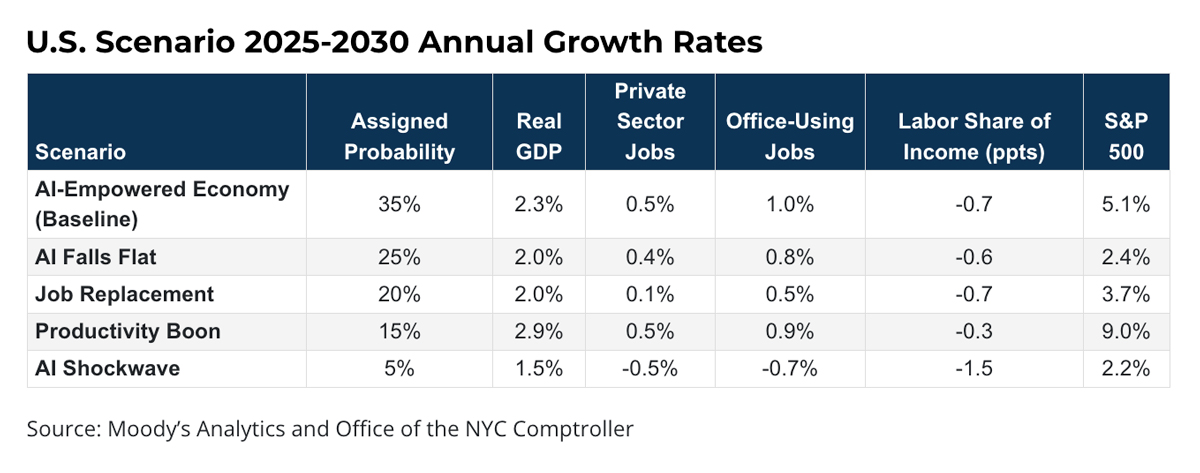
After proposing a similar increase in an April report, “Strengthening the City’s Rainy Day Fund,” that did not mention artificial intelligence, Levine released “AI and New York City’s Fiscal Future” on May 21. It analyzed five scenarios forecasting how AI adoption could potentially help or harm the city’s economy, based on an analysis by Moody’s Analytics published in February.
The scenario deemed most likely to occur is what Moody’s refers to as an “AI-empowered economy,” which assumes that AI will replace some jobs, but also enhance others at a gradual rate, with little disruptive effect on the economy or employment. According to the forecasts, there is a 35% chance this scenario will be the one that plays out in the future.
The next most likely scenario, at a 25% chance, is the “AI falls flat” scenario, under which the markets will deem AI investment “excessive,” with adoption rates, productivity gains and profitability falling short of expectations, which would be followed by a market sell-off.
At a 20% likelihood, the “job replacement” scenario assumes automation displaces workers faster than jobs are created, leading to a rise in unemployment. The “productivity boon” scenario, which assumes AI will drive “broad growth, wages and prosperity” is forecast to have a 15% chance of happening.
The “AI shockwave” scenario, which the analysis pegs as having just a 5% chance of occurring, assumes jobs involving routine cognitive work in finance, law, customer service and administrative support will be replaced faster than the displaced workers can find new jobs.
“What does this disruption mean for New York City’s economy, workforce, and tax base? Will it lead to rapid economic growth? Wide-scale unemployment? A collapse in the stock market?” the report asked. “As of today, there are no clear answers to these questions. Some have called this uncertainty the ‘AI fog.’ But we know enough to at least identify likely scenarios for how AI will affect our city.”
 |
Mark Levine’s Priorities at the NYC Pension System |
 |
Monte Tarbox Brings Diversified Approach to NYC Pensions’ Investments |
 |
NYC Pension System to Invest $4B in Affordable Housing |
Tags: Mark Levine, New York City, New York City Comptroller’s Office