


Yingjin Gan and Francisco Ibanez
Broad market equity indexes are often used as benchmarks for investment performance evaluation. Therefore, they need to be investable, representative, transparent and rules for construction must be clearly specified in advance. However, the structural shift in new stock issuances combined with an anticipated wave of mega-cap public debuts puts traditional index construction methodologies to the test. Standard semi-annual rebalancing schedules struggle with mid-cycle mega-cap listings, potentially leaving institutional allocators temporarily underexposed to major economic shifts.
At the center of this challenge is a core structural trade-off for index providers: balancing timely market representation against the portfolio turnover, transaction costs and operational burden of early IPO inclusion.
The Structural Shift in New Issuances
The operational cost of delayed benchmark inclusion is escalating rapidly because the anatomy of public offerings has transformed. Supported by deep private-market funding rounds, companies are choosing to remain private significantly longer than in the past, entering public exchanges as mature corporate institutions rather than early-stage growth stories. Between the early 2000s and today, the distribution of company age at the time of the initial public offering has significantly shifted, with “senior IPOs” in the top 95th percentile nearly a whole decade older than their 2000s counterparts.
Historically, public equity markets served as the primary incubator for corporate growth, allowing smaller enterprises to list early and experience capital appreciation within a broad benchmark. Today, late-stage private capital enables firms to scale to mega-cap status entirely outside public boundaries. Consequently, when these businesses finally debut, they arrive as massive market forces capable of instantly altering sector weights, factor exposures and concentration limits on their first day of trading.
This supersizing of newly public companies is compounded by severe sector concentration. While raw listing counts frequently skew toward healthcare, driven by clinical-stage biotechnology offerings, the actual capital raised tilts aggressively toward technology. Because many modern broad benchmarks rebalance infrequently, an index can remain systematically underexposed to the exact innovative sectors that are driving broader economic expansion.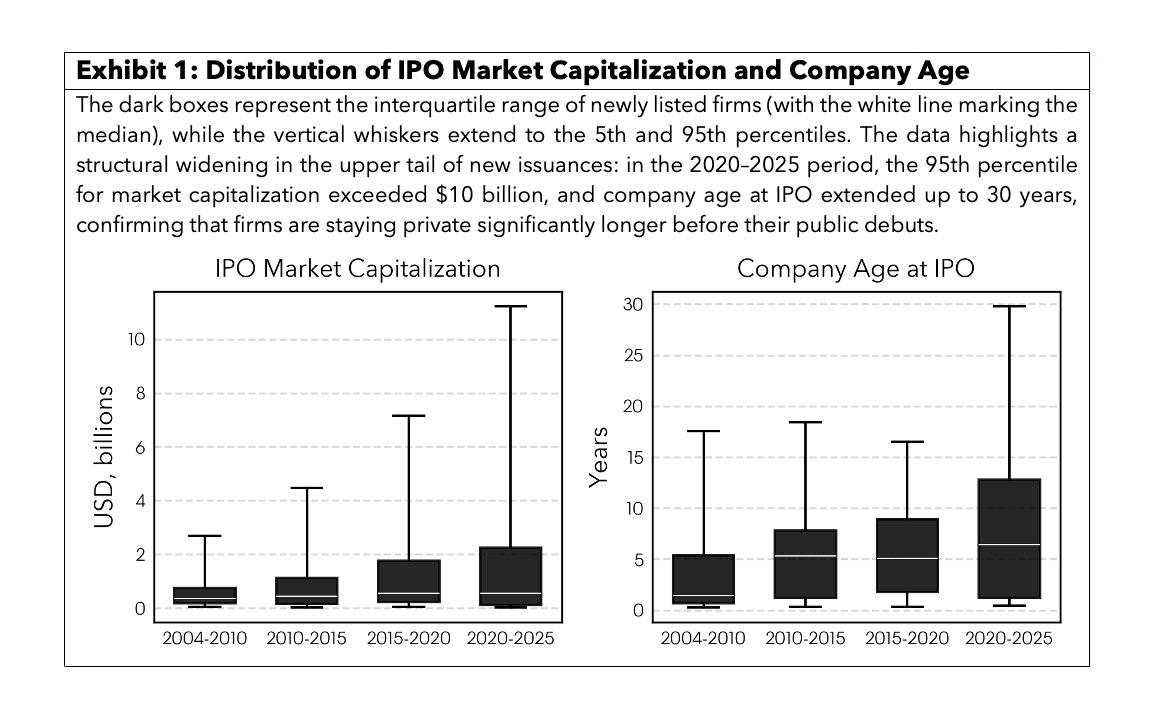
Evaluating Benchmark Representativeness vs. Turnover
To increase a benchmark’s representativeness of investable market opportunities, index providers can include new listings soon after their IPO date through a fast-track inclusion process. However, designing an effective fast-track rule requires navigating a delicate operational trade-off between benchmark fidelity and execution costs. When an index admits a newly listed company, passive trackers must execute trades to mirror the benchmark, incurring explicit transaction costs.
If a broad benchmark adopts an aggressive zero-threshold rule, admitting every eligible stock immediately upon listing, it achieves the highest possible market representation. However, this approach burdens institutional allocators with continuous portfolio turnover. Because more than 80% of new issuances debut with valuations below $2 billion, an aggressive inclusion policy forces managers to repeatedly trade small, relatively illiquid stocks that contribute virtually nothing to broader market representation.
Conversely, delaying all inclusions of newly public equities until scheduled semi-annual reconstitutions eliminates excess trading but decreases market representativeness whenever a major market player lists. For this reason, this trade-off can be balanced by identifying and fast-tracking only “relevant” companies that are sizable enough to make a difference in market representativeness, if included. These IPOs can be systematically identified, based on the market value of the initial offering, relative to stocks already in the benchmark index.
Using approximately 3,000 U.S. IPOs that entered the Bloomberg U.S. Aggregate Equity index universe between December 2003 and December 2025, we can document how IPO investability evolves after listing. Our empirical testing across a sweep of “relevance” size thresholds reveals that the relationship between representativeness and index turnover is highly convex rather than linear. As the inclusion threshold is raised from zero (i.e., the all-inclusive reference index, which includes every incoming IPO) to 0.5, the one-way turnover is cut to 4.56% from 4.61% by filtering out multiple smaller issues. This decreased trading comes at a cost. The tracking error against an all-inclusive reference index is roughly 7 basis points at the 0.5 mark, before doubling and plateauing at roughly 15 bps, as the relevance threshold increases and excludes larger listings. Screening out small IPOs decreases operational complexity but decreases market representation in exchange.
This curve highlights a practical middle ground. Fast-tracking a new IPO only when its free-float market cap exceeds 50% of the 500th-largest index constituent market cap provides a good amount of turnover relief while keeping a muted tracking error to the all-inclusive reference index.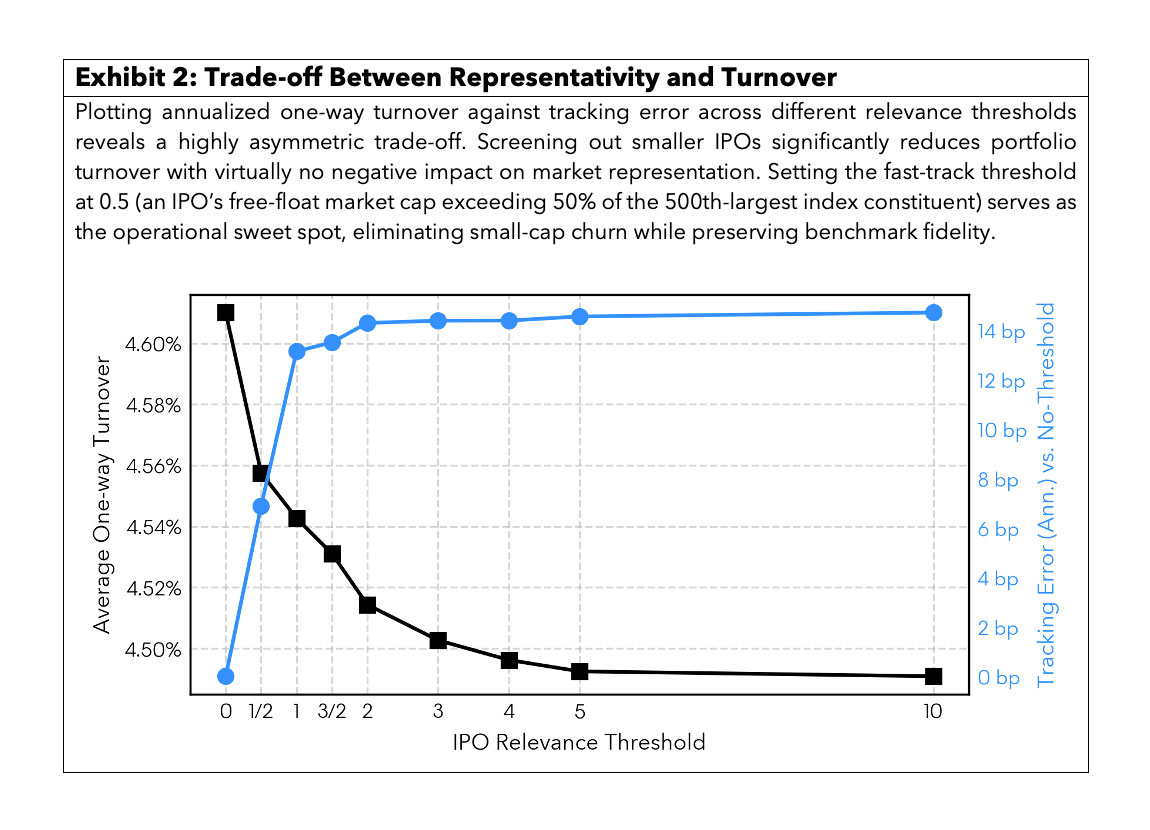
The Marginal Impact of Mega-Cap Float Dynamics
Companies do not typically have all their shares traded freely on an exchange immediately following a listing. A substantial portion of shares are held by company insiders, strategic investors, and owners of restricted stock, keeping initial public float constrained.
Because modern index construction weights constituents by investable free-float market cap rather than total company valuation, the initial impact of a newly added company is heavily constrained by the number of shares effectively offered to the public. While IPOs have historically averaged a float of roughly 20% of their shares, upcoming mega-cap listings are entering the market with single-digit float percentages, keeping their immediate day-one index weight minimal.
Take the case of the recent public offering of SpaceX. Despite receiving a massive valuation of approximately $1.77 trillion, the company had only roughly 4% to 5% of its 13 billion shares available for public trading. Consequently, its resulting weight across broad benchmark indexes is in dozens of basis points, depending on the index size and weighting methodology. This limited allocation is expected to increase as the number of free-float shares steadily increases over the subsequent six to nine months as insider lock-up periods expire. Consequently, the weight that SpaceX received across different indexes that fast-tracked this company, indicates that fears of severe day-one portfolio disruption from fast-tracking mega-caps are often overstated. Because the initial float is so small, the immediate buying required from passive trackers is highly manageable and easily absorbed across existing constituents without causing market dislocation.
SpaceX’s Index Weight Right After Fast-Track (as of June 25th, 2026)
| Index | Coverage | SpaceX’s weight |
| Bloomberg World Large & Mid Cap | World’s top 85% of free-float market cap | 0.10% |
| Bloomberg Developed Markets Large & Mid Cap | DM’s top 85% of free-float market cap | 0.11% |
| Bloomberg 3000 | US top 3000 companies | 0.14% |
| Bloomberg 1000 | US top 1000 companies | 0.14% |
| Bloomberg 500 | US top 500 companies | 0.15% |
| Bloomberg 200 | US top 200 companies | 0.18% |
| Bloomberg 100 | US top 100 companies | 0.28% |
Source: Bloomberg Indices
As detailed in Exhibit 3, initial allocations remain modest across the entire spectrum of Bloomberg’s own benchmark granularity, ranging from just 0.10% in broad global coverage to 0.28% at the extreme end of concentrated domestic benchmarks like the Bloomberg 100. Even when an index is restricted to the top 100 or 200 companies, a low initial float keeps a mega-cap’s day-one footprint small. To put those numbers in perspective, on June 25th, 2026, the single largest constituent in the Bloomberg 100 Index had an 8.5% weight, while the top holding in the World Large & Mid Cap index stood at 4.5%, completely dwarfing SpaceX’s initial allocation. This minimal impact is a direct function of pure free-float weighting. Other index providers that fast-tracked SpaceX without using a pure float-weighting methodology assigned the company an initial weight of up to 1.3%, showing how alternative weighting rules can significantly amplify day-one rebalancing demands.
However, empirical evidence confirms that this float percentage does not stay static; it increases steadily over the subsequent six to nine months as insider lock-up periods expire and secondary tranches of shares enter public circulation. The lock-up expiration creates a predictable, structural expansion of the company’s footprint within the investable universe.
Strategic Implications for Institutional Investors
For institutional allocators, benchmark integrity requires an index that adapts at the speed of the market. In an era of mega-cap debuts, establishing a rules-based, free-float threshold ensures benchmarks reflect the investable market exactly as it forms, maintaining fidelity without imposing unnecessary trading friction.
Yingjin Gan leads Bloomberg’s Index Research Group, where she oversees research and development of index methodologies and new index products across equity, fixed income, commodities, and sustainability. Prior to this role, she spent over a decade managing Bloomberg’s fixed income risk and analytics research team. Yingjin joined Bloomberg in 2008 after working in fixed income research at Lehman Brothers, and holds a Ph.D. in Applied Economics from the Wharton School.
Francisco Ibanez is a senior quantitative researcher on Bloomberg’s Quantitative Investment Research team, focusing on systematic equities index research. Prior to joining Bloomberg, he held quantitative research positions at Credit Suisse Asset Management and the Central Bank of Chile. Francisco holds a Ph.D. in finance from City University of London, a master of financial engineering from UCLA and bachelor’s and master’s degrees from Adolfo Ibáñez University.
This feature is to provide general information only, does not constitute legal or tax advice, and cannot be used or substituted for legal or tax advice. Any opinions of the authors do not necessarily reflect the stance of ISS STOXX or its affiliates.
Tags: Index, initial public offering, Portfolio Construction