

The war in Iran and the surrounding region is slowing global economic activity and is likely to increase inflation in 2026, which could lead to “a close call” with global recession, according to the International Monetary Fund. The agency stated that because of the war, it expects global GDP growth to decline to 3.1% in 2026 from 3.4% last year.
“After withstanding higher trade barriers and elevated uncertainty last year, global activity now faces a major test from the outbreak of war in the Middle East,” the IMF stated in a report released April 14. “The shock’s ultimate magnitude will depend on the conflict’s duration and scale—and how quickly energy production and shipment normalize once hostilities end.”
Economist Mohamed El-Erian, a senior global fellow at the University of Pennsylvania’s Lauder Institute and the chair of Gramercy Funds Management, in a on his LinkedIn page, called the IMF report “sobering” and noted: “Virtually every challenge facing the global economy is poised to intensify due to the fallout of the Middle East War. This includes:
- Insufficient growth;
- Burdensome cost of living;
- Excessive inequality;
- High deficits;
- Large debts;
- Climate change; and
- Limited policy flexibility.”
The IMF also stated that a major energy crisis could erupt if hostilities continue, citing the closure of the Strait of Hormuz, in addition to “serious damage” to energy infrastructure in the region, which is key to the world’s global hydrocarbon supply.
Under the IMF’s reference forecast, which assumes the conflict will end soon and that energy prices will increase a “moderate” 19% in in 2026, global growth will decline to 3.1% this year, with headline inflation of 4.4%. Despite a relatively optimistic forecast, the IMF stated that the decline would be “a sharp deviation from the global disinflation trend in recent years.”
In the fund’s adverse scenario, under which oil prices surge 80% in the second quarter from levels at the beginning of the year, the IMF forecasted global growth dropping to 2.5%, with inflation rising to 5.4%. Under a severe scenario, in which the hit to global growth is “substantial and longer lasting,” the IMF expects global growth would sink by 130 basis points to 2% this year and next, with inflation exceeding 6%.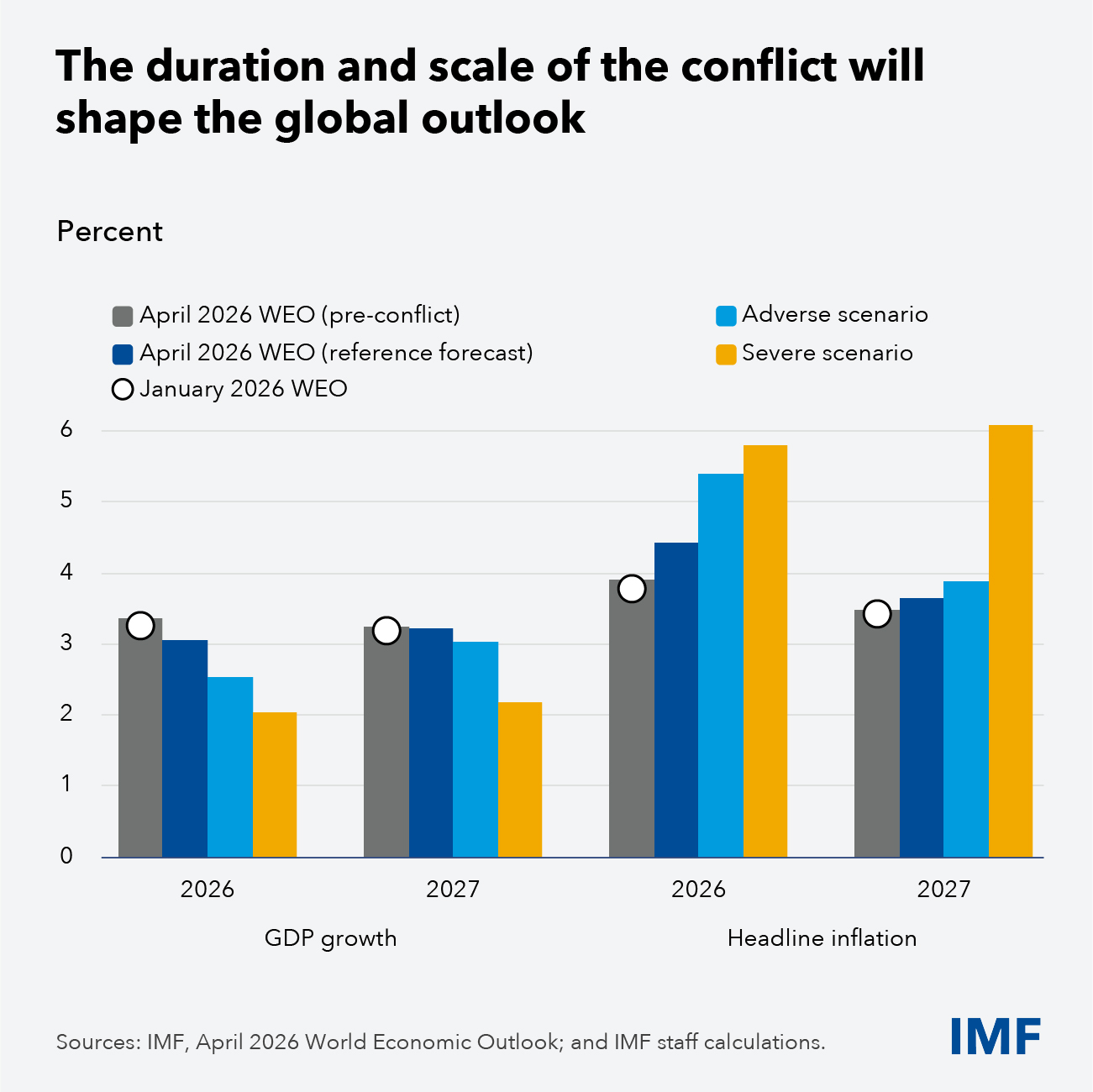
“A longer or broader conflict, worsening geopolitical fragmentation, a reassessment of expectations surrounding artificial‑intelligence‑driven productivity, or renewed trade tensions could significantly weaken growth and destabilize financial markets,” the IMF stated. However, it also projected that growth could pick up depending on productivity gains from artificial intelligence or if trade tensions ease on a long-term basis.
“Fostering adaptability, maintaining credible policy frameworks, and reinforcing international cooperation are essential to navigating the current shock while preparing for future disruptions in an increasingly uncertain global environment,” the IMF report stated. “Where conflict erupts, acute macroeconomic trade-offs and scarring follow and last well beyond the immediate wartime shock.”

Tags: IMF Global Growth Forecast, Inflation, oil and gas, recession risk, war