

Sales of insurance-linked securities totaled $24.7 billion in 2025, a record year for the market, coming on the back of strong investor demand and benign market losses, according to a report from the Swiss Re Group.
Insurance-linked securities, which allow insurers to transfer the risk of an event such as a wildfire or hurricane to investors through bond issuances, have become more popular due to their lack of correlation with traditional securities markets.
Swiss Re’s report noted that 2025 was the sixth consecutive year in which insured losses due to natural disasters exceeded $100 billion, “driven largely by a high frequency of medium-sized events, including severe convective storms and wildfires, rather than by a concentration of major peak-peril catastrophes.”
Despite this, overall insured losses remained lower than early forecasts had suggested, according to Swiss Re.
The total outstanding notional amount of catastrophe bonds in the primary market—the total value of capital exposed to insured events—increased to nearly $60 billion at the end of the year, up from $48 billion at the end of 2024. The ILS market has grown at a 13.5% compound annual growth rate since 2020, when notional outstanding stood at $37 billion, Swiss Re noted.
In the report, Swiss Re also stated that while much of the ILS market was dominated by demand for U.S. wind exposures, the firm saw an increase in demand for nontraditional risks such as cyberrisk, wildfire-only and severe convective storm-only catastrophe bonds. Severe convective storms are storms that generate tornadoes or thunderstorms with winds of nearly 60 miles per hour, hail of at least 1 inch in diameter, and flash flooding.
The reinsurer highlighted the low correlation between the ILS market and other bond markets—the Swiss Re Cat Bond Total Return Index, designed to measure the returns of the ILS or catastrophe-bond market—returned 11.4% in 2025.
Swiss RE Index Comparison 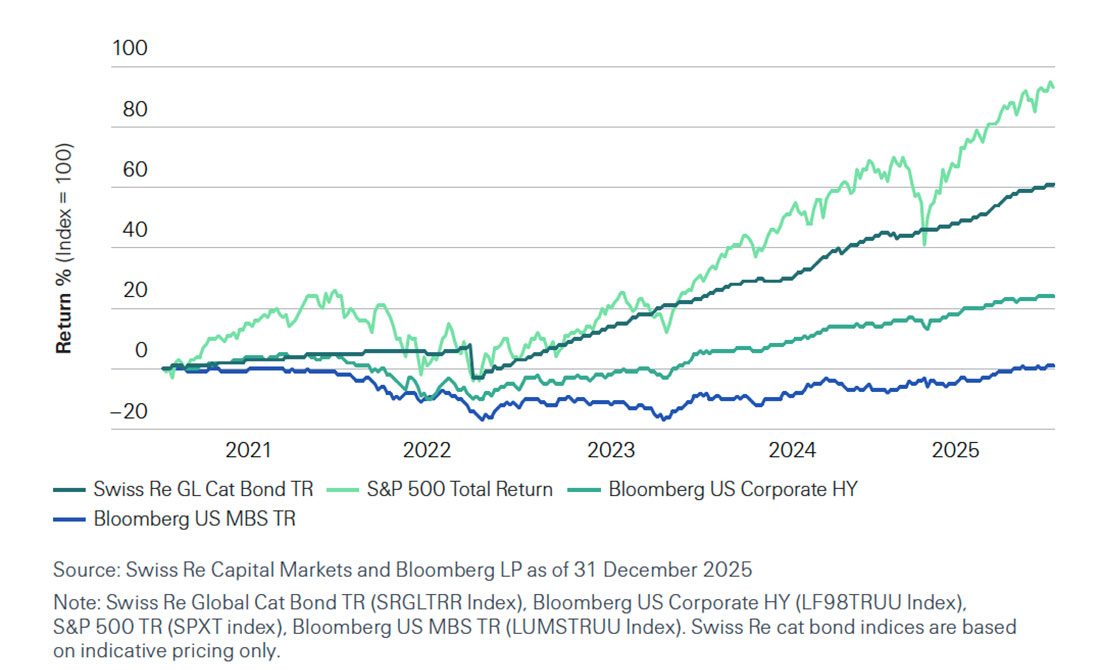
“This was supported by high running coupons and limited direct loss activity affecting outstanding cat bonds,” the report stated.