
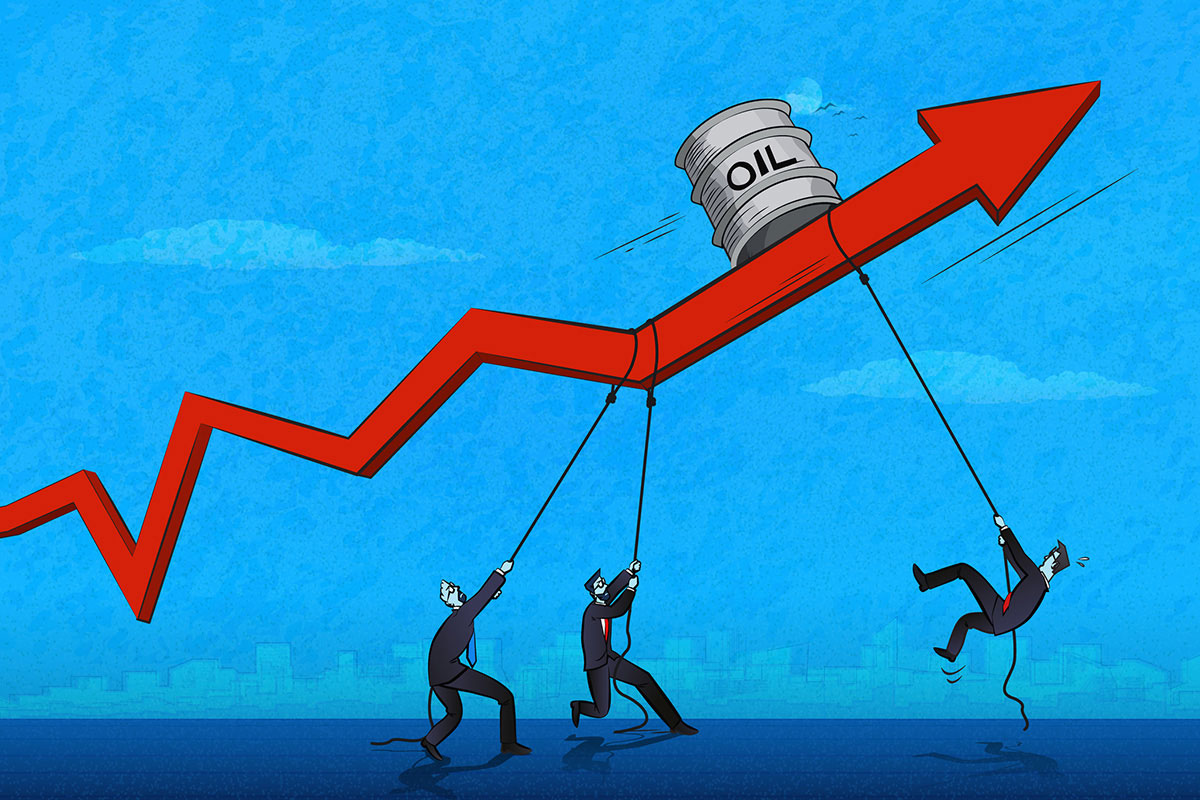
Turmoil in the Middle East as a result of joint U.S. and Israeli strikes on Iran—and Iran’s retaliation throughout the region—is creating an uncertain picture over the future of the Federal Reserve’s rate policy, as rising oil prices are set to drive core inflation indexes higher.
Morgan Stanley, in a research note, estimated that a 10% rise in oil prices as a result of a supply shock would lift headline consumer prices by 0.35% over the next three months. Prices of crude oil futures have increased by more than 20% since the conflict began on February 28.
“The problem with downward shocks in oil supply is that they simultaneously drive inflation higher while pushing growth lower,” says Yung-Shin Kung, CIO of Mast Investments. “[Fed Chair] Jerome Powell estimated that a $10 increase in oil prices, which we’ve already exceeded, increases inflation by 0.20% and decreases growth by 0.10%.”
A report from Oxford Economics noted that the eurozone and the U.K. are both relatively vulnerable to the potential second-round effects of surging energy prices. The advisory firm expects the Bank of England to keep monetary policy restrictive amidst the backdrop of rising energy prices and expects the European Central Bank to keep rates on hold, unless the surge in energy prices persists, in which case the ECB could opt to tighten policy.
Joachim Nagel, president of the German Bundesbank and a member of the governing council of the European Central Bank, said in a statement Thursday that the economic repercussions of the war in Iran would depend largely on how long the conflict continues, adding that prolonged hikes in energy prices would lead to higher inflation and weaker economic activity across the Eurozone.
“It is still too early to draw any monetary policy conclusions from this volatile situation,” Nagel said. “We are well advised to carefully analyze the impact on our medium-term inflation target.”
The Oxford Economics report also concluded that it is too early to reach economic decisions.
“So far, the effects of the Iran conflict aren’t sufficient for us to change our baseline forecast for monetary policy, which still assumes the Fed will cut interest rates by 25bps at both its June and September meetings,” the report noted.
Oxford Economics expects the energy shock to add between 0.3 and 0.4 percentage points to global inflation, while trimming global GDP growth by 0.1 percentage point this year.
“This risk aversion has resulted in sharp market swings, less confidence, and greater caution among institutional investors, as they assess the potential economic impact of a protracted conflict in a region vital for global energy supplies,” says Nick Tsafos, a partner in accounting firm EisnerAmper. “In times of geopolitical turmoil, we often see increased investment in industries like healthcare, utilities, defense, and energy, which tend to offer resilience amid volatility.”
The conflict in Iran has further increased market volatility, with precious metals declining, and the dollar, oil prices and gas prices rising. The S&P 500 Index of U.S. stocks is down over 2% since the beginning of the conflict, while some indexes, like South Korea’s KOSPI, have fallen as much as 12% in a single day.
“Markets have taken this event in stride, and price moves have, if anything, been surprisingly muted. Consequently, there’s likely room for moves to extend if the situation deteriorates or fails to find rapid resolution,” Kung says. “Second, the global economy doesn’t necessarily have the buffers to deal with these pressures, and we see the recent upward trend in developed market interest rate levels as cautionary.”
Some industry observers have noted that in the medium and long terms, following destabilizing geopolitical events, markets have often moved higher. A report from J.P. Morgan noted, “unless there’s a major economic disruption, volatility from geopolitical events tends to be short-lived.”
“Unlike in the previous wars, today the U.S. is the world’s largest producer and a net exporter of oil, providing a cushion against prolonged high oil prices in the longer term,” says Jay Winthrop, a managing principal in Douglass Winthrop Advisors LLC. “Turning again to the previous wars, the Federal Reserve lowered interest rates each time, and bond yields were lower still six months after the start of hostilities. Earnings were generally higher a year after each invasion, and the price-to-earnings multiple of the S&P 500 rose.”
 |
Geopolitical Volatility Defines Markets to Start 2026 |
 |
Geopolitics Operates with Long and Variable Lags |
 |
Politics and Interest-Rate Expectations Drove Volatility in 2025 |
Tags: Geopolitics, Inflation