

 The size and pace of the artificial intelligence investment boom are unprecedented, with vast amounts of capital raised to support a rapid build-out. Over the next five years, we expect an infusion of roughly $5 trillion to bring the physical infrastructure of AI into place. It’s an “all hands on deck” moment for capital markets. For asset allocators, the chance to invest in AI is a generational opportunity. But it also poses unique challenges to maintaining adequate portfolio diversification and managing risk.
In Historical Context
The history of past capital investment booms offers useful insights into how the AI cycle may play out. Specifically, we observe a consistent progression of distinct phases that have repeated over time.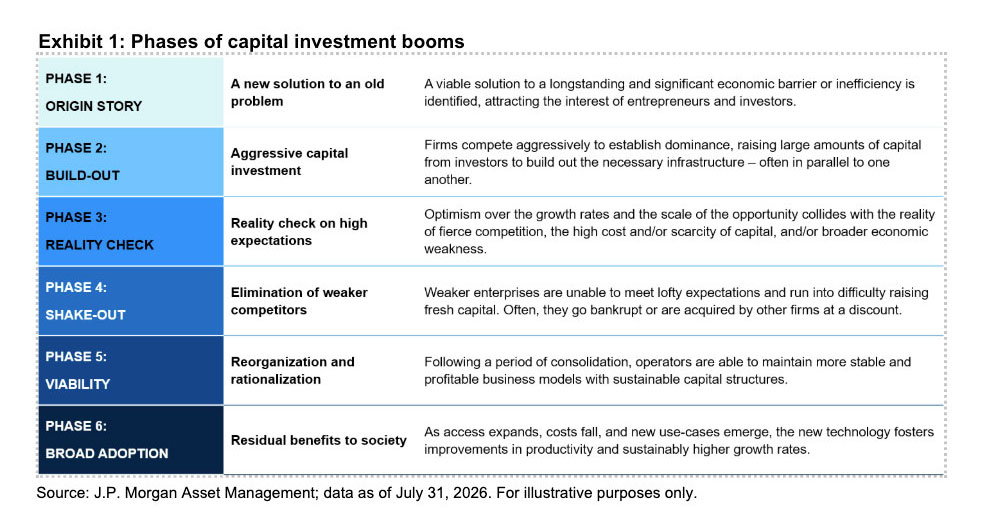
The key takeaway: These are early days for the AI boom. The technology is evolving quickly, as are the market and regulatory environment. As firms compete for dominance, enthusiastic investors have been supplying ample capital for the build-out. However, the next phase of the boom may be arriving in which markets apply more critical judgement in evaluating the scale and sustainability of the revenues needed to operate a highly capital-intensive technology over time. Disruption among key players is inevitable, but ultimately, we believe, widespread adoption of the technology will lead to higher levels of productivity and growth.
Public Markets Lead the Way
During the early phase of the build-out, firms and sectors that are suppliers to the AI boom (often referred to as the “picks and shovels” trade), may offer the best investment opportunities. Examples include advanced chips, memory, data center infrastructure and power generation. Conversely, firms and sectors seen as vulnerable to AI are experiencing a significant, and at times indiscriminate, sell-off. Both the winners and losers include mostly public companies, investible via public equity markets.
Allocators should recognize that the recent strong relative performance of passive strategies likely reflects a widespread market consensus in identifying the winners and losers in the early stages of the AI boom. Rising market concentration is the result, as the success of the firms making money from AI is balanced against declining valuations for companies seen as vulnerable to the technology. However, as the build-out matures and competition reveals key players’ relative strengths and weaknesses, skilled active managers will have more unrealized upside to play for. They can position portfolios away from conventional wisdom and back toward fundamentals.
The “Core AI” Ecosystem Requires Diversification
We consider the “Core AI” ecosystem to include both the key AI model providers and the large technology firms that are now subsidizing the costs of data center construction. Today the demand for computational power far exceeds the supply and it is widely assumed that the construction of data centers delivers positive economic returns. Hyperscalers are raising capital from a wide range of sources, and at an equally wide range of prices, to get the physical AI infrastructure in place.
Allocators recognize that they are adding exposure to AI through a number of asset classes: public equity, venture capital and growth equity, private credit, and infrastructure. While each of these offers potentially valuable investment attributes, they all depend, to varying degrees, on the ultimate ability of AI firms to achieve sustainable profits. Hyperscalers have the financial strength to subsidize AI for an extended period, but even the strongest among them will one day reach their limit.
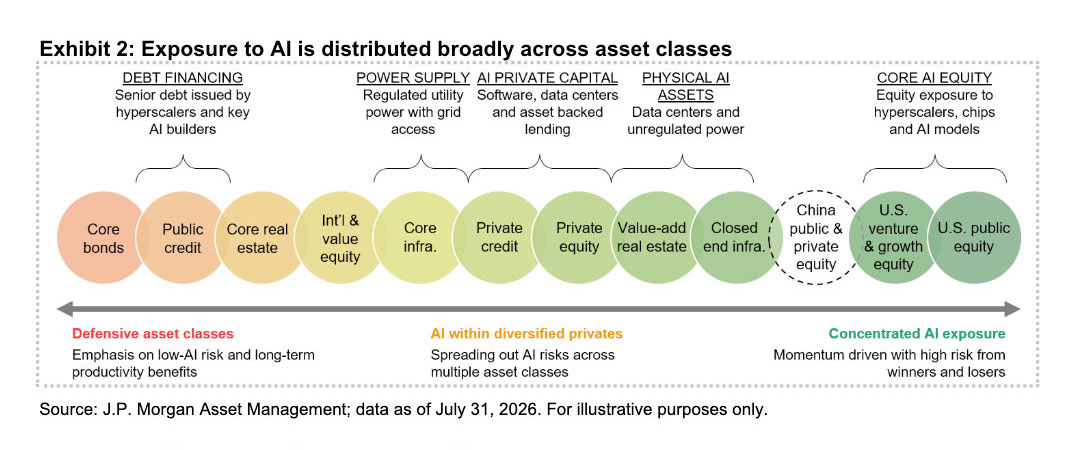
As the AI build-out matures and data center supply expands, it will become more critical to balance the cost of the capital needed to build and operate data centers against the revenue streams that AI can generate from end users. Competition among models will exert downward pressure on pricing, while ongoing capex needs will keep operators’ costs high. The potential for disruption among key players—witnessed in many past capital investment booms—is real. Diversification across public and private markets will help limit portfolio risk, but it may not solve the challenge of investing amid a broader shakeout among core AI providers.
Assets classes with genuinely defensive characteristics may thus become a critical element of risk management in the AI boom. These include sectors with low-intensity AI exposure, such as regulated utilities (core infrastructure) or near-zero AI exposure (core real estate). Other sectors offer defensiveness related to positioning in the capital structure (investment grade debt). Traditional defensive assets such as core bonds also have a role to play, particularly given today’s elevated yield environment.
Positioning For Long-Term Productivity
In the long run, a highly competitive AI ecosystem should increase innovation and reduce the cost of AI to end users, resulting in widespread adoption of the technology. AI is effectively borderless and broadly accessible to fairly unsophisticated users, which makes its target market truly global. Market sectors and regions that have played a limited role in the development of AI will become beneficiaries of the potential productivity gains that it can deliver.
We believe global equity markets, and in particular AI “laggards” in Europe, Japan and certain emerging markets, should remain in portfolios as a less expensive (lower multiple) means of investing in AI’s long-term potential. With less exposure to the core AI set of model builders and hyperscalers, these markets may offer sectors that can wait out the worst of AI disruption and reap a “late-mover” advantage in capturing the best of AI’s potential.
Conclusion
The AI storyand especially the extraordinary investment opportunity it presents–may not follow a predictable narrative. We believe investors will need both tactical flexibility and strategic discipline as the story unfolds. Investment skill can identify opportunities and navigate volatility, while discipline in portfolio construction can avoid excessive risk concentrations.
Jared Gross is the head of institutional portfolio strategy at J.P. Morgan Asset Management responsible for providing insights and solutions to institutional clients, including corporate and public pensions, endowments, foundations, and healthcare institutions.
This feature is to provide general information only, does not constitute legal or tax advice, and cannot be used or substituted for legal or tax advice. Any opinions of the author do not necessarily reflect the stance of ISS STOXX or its affiliates.
Tags: Artificial Intelligence, Capital Markets, data centers, fundraising, opinion