

While strong equity markets propelled the returns of higher education endowments for another year, the institutions increased spending from their investment pools to help stabilize their organizations’ operations, according to the 2025 NACUBO-Commonfund Study of Endowments.
The 657 higher education endowments surveyed by the National Association of College and University Business Officers and asset manager Commonfund—collectively managing $944.3 billion in assets—reported an average 10.9% return in the 2025 fiscal year and an annualized 10-year average return of 7.7%.
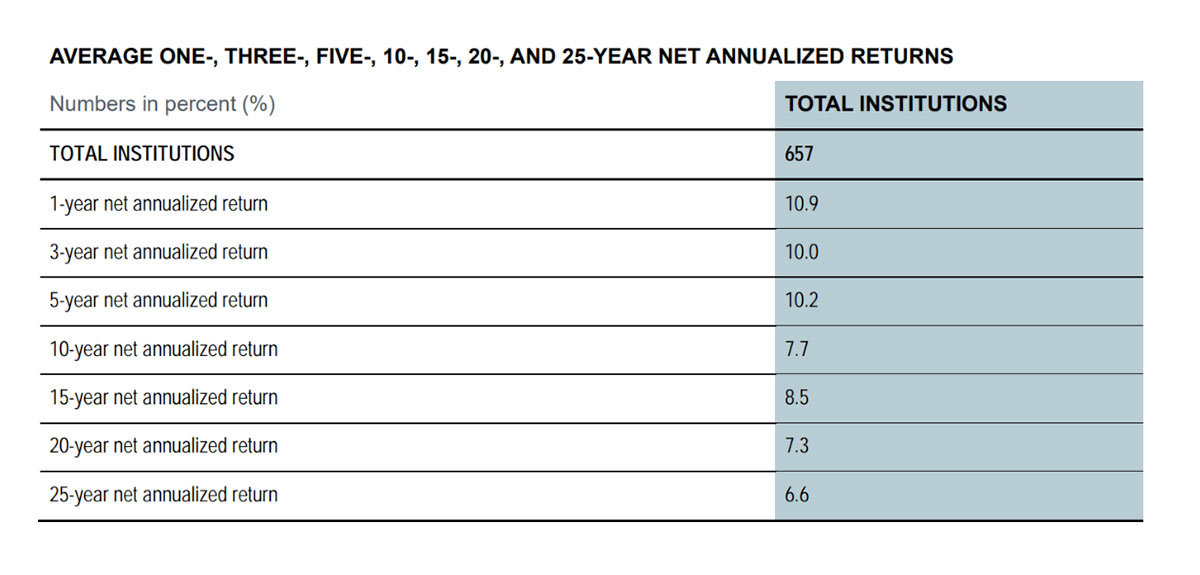
Source: NACUBO-Commonfund Study of Endowments
During the fiscal year, the highest returns came from actively and passively managed global equities and passively managed developed non-U.S. markets, which both returned about 17%. The study noted strong returns in private markets and the best returns for fixed-income assets in years, which led to similarly strong returns of institutions of all sizes.
“This year’s report shows how important well-managed endowments are to colleges and universities,” said Kara D. Freeman, NACUBO’s president and CEO, in a statement. “Endowments help fuel innovation and serve as a stable foundation for institutions. Because of challenges in the economy, some institutions relied more heavily on their endowments—but that additional spending benefited students, faculty, staff, research, operations, and more. Endowments make college possible and more affordable, and contribute to better lives for all.”
Asset Allocation
Private equity and other private market assets continued to account for large parts of these endowments’ portfolios. According to the study, alternative investments accounted for 54.5% of all assets, with public equities and fixed income accounting for 31.5% and 11% of all assets, respectively. Another 3% was allocated to “other” investments.
Private equity had the largest average allocation at 16.8% followed by marketable alternatives (15.4%), U.S. equities, (13.7%), venture capital (12.2%) and fixed income (10.7%).
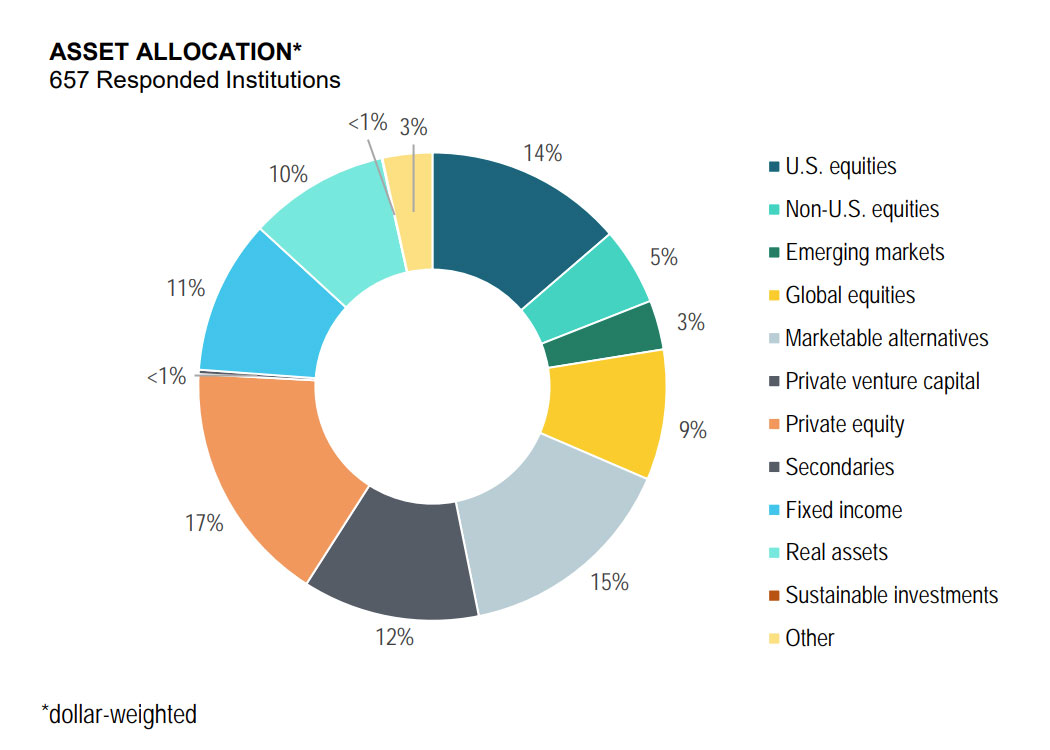
Source: NACUBO-Commonfund Study of Endowments
Alternative investment returns, including private equity, largely bounced back after years of weakness following the COVID-19 pandemic. Still, endowments with higher allocations to public equities have outperformed those with heavy alternatives allocations in recent years, noted George Suttles, executive director of the Commonfund Institute, in the report.
“Private/alternative strategies have proven to add value to endowment portfolios,” Suttles said in the report. “The larger point is that endowments that are well diversified are better positioned for long-term success in the ever-changing conditions found in global financial markets.”
Rob Appling, a managing director at Wilshire Associates, notes that, increasingly, manager selection will become more important for private markets.
“I think it’s going to be more than just having beta exposure to private equity or asset class exposure; it’s really going to be more and more critical to have success within manager selection,” Appling says, highlighting the fact that alternatives have been strong outperformers for endowments over long periods of time. “I think the delta between top-quartile private equity managers and the bottom quartile will continue to grow and expand as more dollars chase fewer deals.”
Endowment Spending
Higher education endowments have increasingly provided a larger share of their institutions’ budgets, the NACUBO-Commonfund study found. In fiscal 2025, endowments provided an average of 15.2% of operating budgets, up from 14% in 2024 and 10.9% in 2023.
Larger endowments, however, contribute even more. The two largest cohort sizes in the study—those endowments with between $1 billion and $5 billion in assets and those with more than $5 billion—contributed 18% to 19% of operating budgets.
These endowments have faced a volatile year: federal funding cuts, investment tax increases as a result of the One Big Beautiful Bill Act, liquidity concerns, and declining enrollment at their institutions.
“When I meet with endowment investment committees and boards, there’s a lot of other factors that are not investment-related that they’re facing and concerned about,” says Laura Wirick, a managing principal in Meketa Investment Group. “So it’s almost like a little bit of a dichotomy … we’re getting all these scare headlines, but the investment portfolio is doing that well, and it’s nice to be a bright spot because a lot of these institutions do need to rely on their investments more.”



Tags: Commonfund, Endowments, National Association of College and University Business Officers