


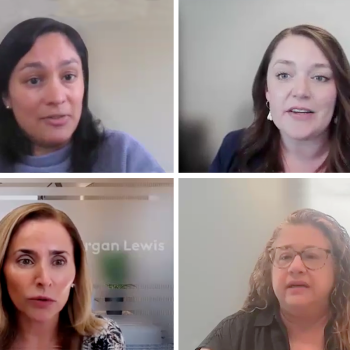
From left: Matt Zumbach, Josh Rabuck, Amy Resnick
Institutional investors can benefit from the cross-pollination of ideas with their peers, according to two investment office leaders, who discussed in a CIO webinar what information about their peers is beneficial to them and their work.
Webinar panelists Josh Rabuck, CIO of Indiana University Health, and Matt Zumbach, president and treasurer of the Baylor Oral Health Foundation, come from two institutions that could not be more different. Zumbach, who had previously worked at Aon and Northern Trust, is the sole investor at the $100 million foundation, while Rabuck oversees more than $9 billion in assets with a team of eight investment professionals.
The webinar reviewed the kinds of information the allocators want to see from peers about staffing, operations, technology and governance, and what kind of peer-related information allocators find hardest to obtain.
The webinar also served notice that Chief Investment Officer is conducting its inaugural Allocator Insights survey. The publication hopes to collect and present information that could be valuable to asset owner organizations, recognizing the significance of accurate data to the entire allocator community. Topics in the survey—and in the discussion with Rabuck and Zumbach—included investment-team structure; technology and artificial intelligence; and governance and asset allocation practices.
Webinar speakers discussed how they utilize insights from similar asset owner surveys and what else they look for.
Watch the webinar here.
Benchmarking With Peers
Allocators are quite interested in what their peers are doing, but at Indiana University Health, Rabuck said its unique mandate makes benchmarking its investment performance against other allocators, even one healthcare system to another, less useful, because different institutions have different priorities, risk and structure.“Peer performance is something that is interesting, but we don’t anchor to that,” Rabuck said. “We have our own unique set of liabilities that nobody else has. We manage the portfolio quite differently than our peers.”
Still, he sees value in understanding the qualitative aspects of what other institutional investors are doing.
“The compelling question I am always trying to find in surveys and peer data is more about: What are those leading indicators of the effectiveness of an investment office?” Rabuck says. “That, in my mind, could center around a handful of things, [including]: investment outcomes, decisionmaking quality and the organization effectiveness.”
For Zumbach—the foundation’s only investment staff member, working with three additional, part-time staff—qualitative insights from other allocators can be extremely helpful.
“I look at a lot of these surveys, I look at asset allocations, [and] I look at performance, but I really want to know: What is actually driving your investment decisions?” Zumbach says. “What has actually worked for you? What has provided some positive outcomes? And how do you pull [that] … story when it’s just data?”
Rabuck noted that he also wants to be more cognizant of how his peers are navigating their technology stacks—including the integration of artificial intelligence—a topic on which he said is hard to find good data, as many institutional investors are just embarking on the adoption of AI tools in the investment office.
Implementing AI
Zumbach noted that the small staff at his foundation and the limited resources available mean he has to speed up the learning curve so that he and the fund can best take advantage of AI. He noted for emphasis that Baylor Oral Health has recently moved from a paper-based office to a digital one and is interested in how it could benefit from AI.“At 45 years old, I’m the AI expert within this organization,” he said. “I am trying to get up that learning curve as fast as I possibly can with [these] resources.”
Rabuck said his staff is exploring the use of various AI tools to assist with workflow, but the fund currently has no strict AI governance structure in place beyond what the larger organization’s information technology office requires. As a healthcare system, Rabuck said, any tool used by the fund will have to be compliant with the Health Insurance Portability and Accountability Act.
Both speakers also discussed the implications of AI tools replacing junior staff within organizations. For Rabuck—whose investment team has only senior members—AI is increasingly being used for the kind of work a junior-level person might otherwise do.
“A few years ago, when we started using the AI tools that were available, I told our team that I wasn’t going to hire an analyst until somebody could prove to me that we needed one,” Rabuck says. “What I meant by that was: Bring me your analyst-level tasks, and if I can’t [complete the work] … using AI, then we will have a conversation.”
Readers interested in completing the survey can do so at the link above. Once completed, CIO will share information and insights from the results.
 |
What Do Limited Partners Want From Their Managers? |
 |
Inside Investment Offices: What Allocators Can Learn From Each Other |
|
CIO Webinar: What Limited Partners Want |
Tags: limited partners