


Exchange-traded funds are playing a larger role in institutional investors’ portfolios and, for some, becoming a core holding.
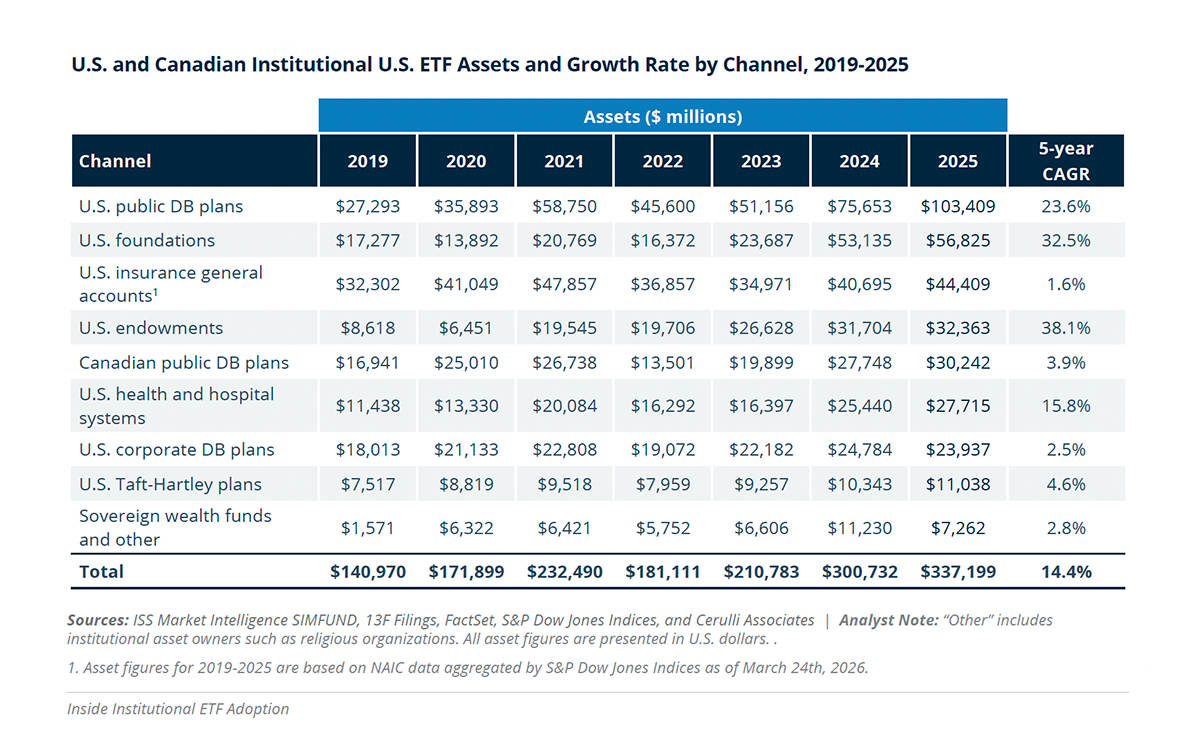
A new report from Cerulli Associates and Invesco found that U.S. and Canadian institutional investors—public and corporate pensions, endowments and foundations, insurers, and health care systems—have nearly doubled their ETF assets under management over the last five years to $337 billion at the end of 2025.
“These client segments are actively looking to allocate more or reallocate into ETFs—either as a tactical tool they’re using to make market bets or as a core portfolio holding—versus the legacy use case as an operational tool to equitize cash or initiate or maintain exposures before they hire a separate account or active manager,” says Brendan Powers, director of product development research at Cerulli.
ETF use is increasing across the industry. According to data from LSEG, the U.S. ETF industry had $461.8 billion in inflows through the first quarter of 2026, with total U.S. ETF assets under management reaching $13.651 trillion.
The allure of many ETFs—including low fees and ease of use—has led to asset managers increasingly launching ETF strategies. According to data from Morningstar, there are now more listed ETFs than there are publicly listed companies in the U.S.
ETF Use Cases for Allocators
In qualitative interviews conducted with investment office leaders at 31 institutional funds which each hold at least $1 billion in assets, Invesco and Cerulli identified several primary factors these investors cited for the increased adoption of ETFs, including:
- Improved liquidity;
- Operational efficiency;
- An expanded menu of ETFs across asset classes;
- Longer performance track records as ETFs mature;
- The ability to deploy capital quickly in one diverse product;
- Lower fees; and
- The ability for allocators to partner with ETF issuers to bring new innovative products to market.
Several institutional CIOs said they could use ETFs to replace what they considered to be expensive, underperforming active managers in their portfolios, especially when the allocators did not have sufficient asset size to command lower-cost exposure to a manager in a separate account.
“When I inherited the portfolio 3.5 years ago, it had been 100% active management, and it had done very poorly,” one anonymous foundation CIO told the researchers. “There were a lot of expensive, mediocre-performing equity managers. So we fired almost all the U.S. public equity managers, and the thinking was: Let’s go 50% passive, 50% active. … [With index-tracking ETFs,] you have daily liquidity and you’re paying probably like 5 basis points or something. It’s basically free.”
Some institutional investors are using ETFs as a public proxy for private markets—a way to get exposure while their alternatives managers put money to work.
“If you’ve hired a private credit manager, and that manager is going to take some time to call the capital, rather than just putting the money in a Treasury bill ETF or a cash equivalent, why not invest it in an ETF that has a high correlation to private markets?” asks Garrett Glawe, Invesco’s head of asset owner ETF specialists.
One public plan official reported using ETFs to make tactical shifts in a fixed-income portfolio, finding it could easily move in and out of ETFs to change duration and credit exposures.
“They can use ETFs to readjust to different points on the curve or even to adjust the credit quality of the portfolio [to] toggle between investment grade and high yield,” Glawe says.
The Largest Adopters of ETFs
U.S. public pension funds are the largest investors in ETFs, managing a total of $103 billion in ETF assets out of $337 billion estimated to be held by U.S. and Canadian institutional investors, according to Invesco’s and Cerulli’s methodology.
Of the 25 public funds with the most AUM invested in ETFs, 17 were public defined benefit plans. U.S. foundations and endowments followed public plans with $56.8 billion and $32.4 billion in assets under management in ETFs, respectively.
Largest 10 U.S. and Canadian Institutional Asset Owners by U.S. ETF AUM, 2024 – 2025 ($M)
| Institution | Country | Channel | 2024 Assets | 2025 Assets | |
| 1 | California Public Employees Retirement System | USA | Public DB | $9,203 | $21,827 |
| 2 | Healthcare of Ontario Pension Plan Trust Fund | Canada | Public DB | $12,845 | $12,939 |
| 3 | Municipal Employees’ Retirement System of Michigan | USA | Public DB | $7,168 | $8,841 |
| 4 | Alberta Investment Management Corporation | Canada | Public DB | $5,313 | $6,494 |
| 5 | Teacher Retirement System of Texas | Canada | Public DB | $2,370 | $5,476 |
| 6 | State of Tennessee, Department of Treasury | USA | Public DB | $5,780 | $4,876 |
| 7 | State of New Jersey Common Pension Fund D | USA | Public DB | $2,754 | $4,124 |
| 8 | State of Wisconsin Investment Board | USA | Public DB | $1,952 | $3,952 |
| 9 | Adventist Health System Sunbelt Healthcare Corporation | USA | Health & Hospital System | $3,125 | $3,007 |
| 10 | Federation des Caisses Desjardins du Quebec | Canada | Public DB | $2,250 | $2,753 |
Sources: Cerulli Associates, ISS Market Intelligence Simfund
Analyst Note: Institutional includes any ETF asset owned by an institutional asset owner. This excludes insurance general accounts’ and institutional asset managers’ use of ETFs within managed products. Includes only institutional asset owners filing a 13F. All asset figures are presented in U.S. dollars.
Some public plans stood out in their prolific use of ETFs, such as the Municipal Employees’ Retirement System of Michigan, which allocates $8.8 billion of its nearly $17 billion portfolio to ETFs under CIO Jeb Burns.
“At least as far as ETF usage goes, approximately 50% of their total portfolio is invested in ETFs, and that includes their private markets,” Glawe says.
MERS of Michigan also takes advantage of the ability to lend out ETF shares as part of its securities lending program. The program raised $1 million in securities lending revenue for MERS, Glowe noted.
ETF adoption was growing fastest among U.S. endowments, at approximately a 38.1% compound annual growth rate over the past five years, according to Invesco and Cerulli, nearly double the 14.4% CAGR of the institutional ETF market.
The largest U.S. corporate DB plans that owned ETFs included those of Lockheed Martin Investment Management ($1.094 billion), Dow Chemical ($253 million), Cisco Systems ($202 million), CVS Health ($135 million) and Deseret Mutual Benefit Administrators ($102 million).
 |
How Insurers Have Used ETFs to Manage Equity Exposure |
 |
Institutions Eye ETF Seeding, but There Are Some Trade-Offs |
 |
Allocators Increase ETF Use to Diversify Exposures |
Tags: Cerulli Associates, ETFs, Invesco