
Finding the Right Sports and Media Investment Opportunities

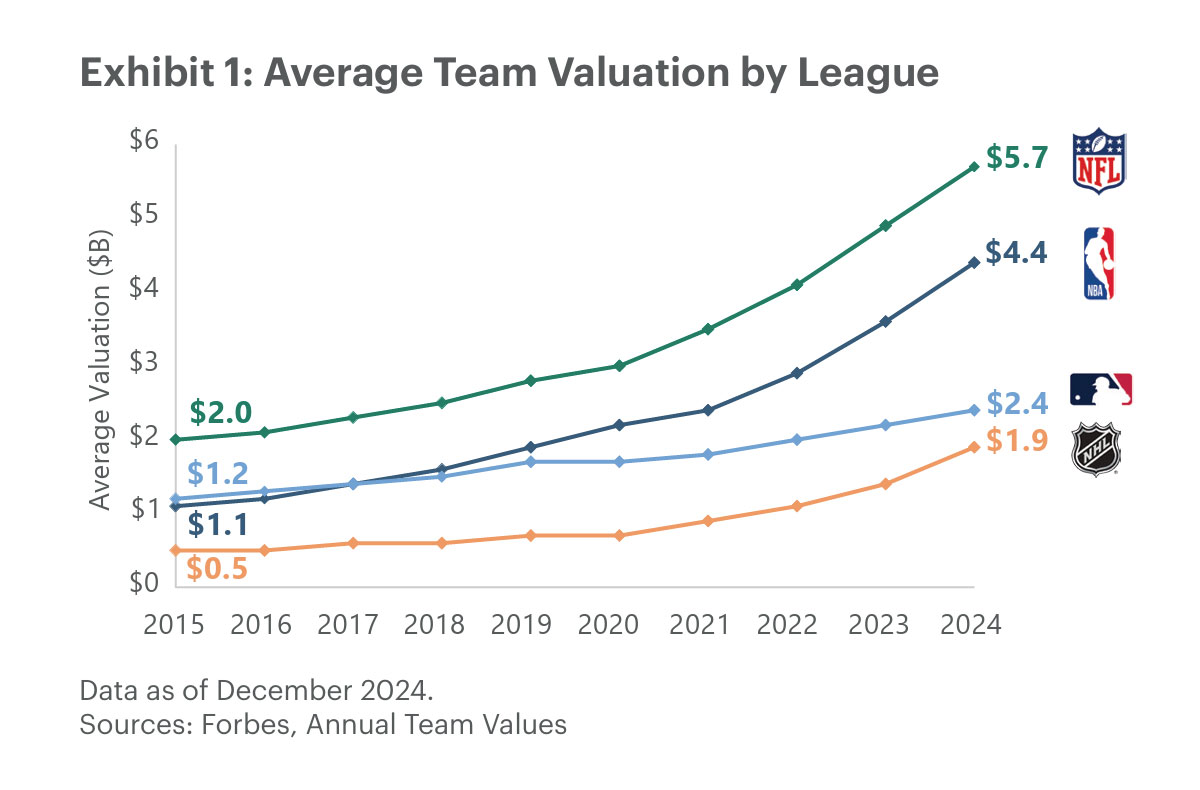
With franchise valuations across major U.S. sports leagues hitting record levels, investors are looking into the broader sports and entertainment ecosystem for opportunities they can add to their portfolios.
The largest sports leagues—such as the National Football League, the National Basketball Association and Major League Baseball—had historically been closed to outside investors. But, in 2019, Major League Baseball began to allow private equity investors to take stakes in its teams. Soon after, more leagues began accepting outside private equity investment, with the NFL the latest in 2025. The leagues tend to hand-select the investment managers allowed to take stakes in teams.
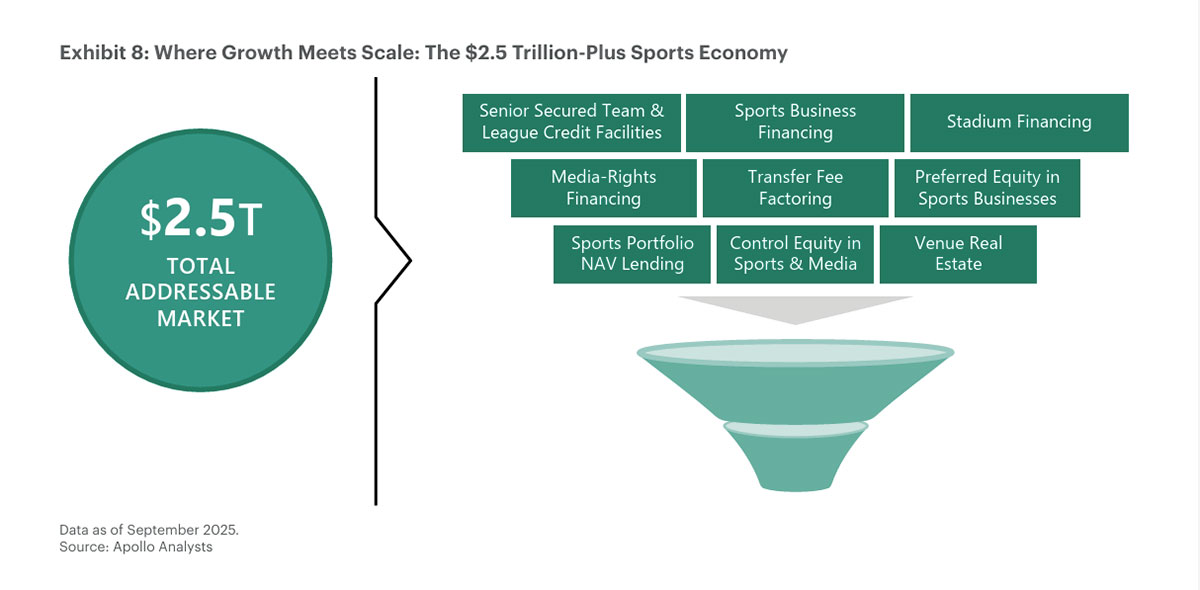
Rising demand for stakes in sports teams has led to a surge of opportunity in the broader media and sports landscape. According to a report from Apollo Global Management, the sports industry represents an addressable market of at least $2.6 trillion.
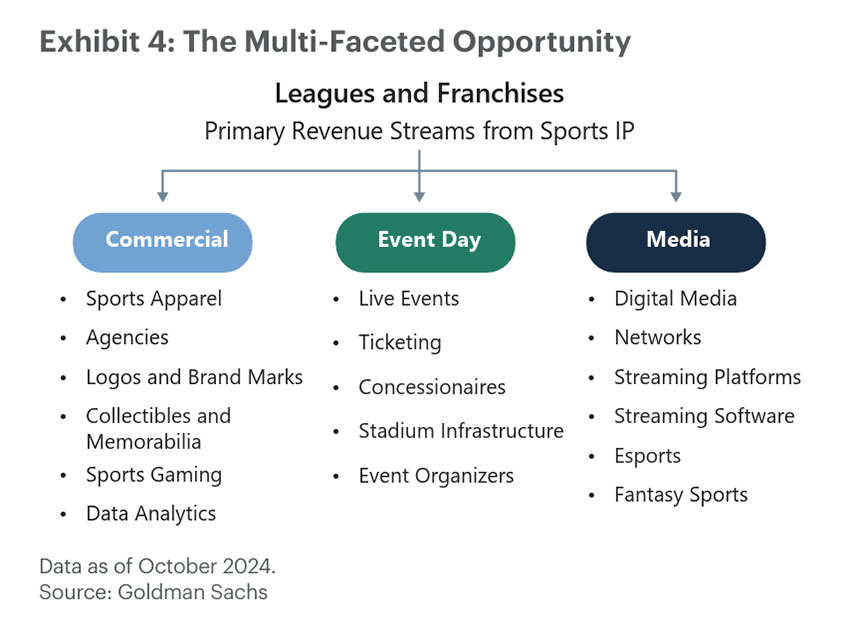
“For the last 35 years, private equity has invested in the ecosystem around sports franchises and their adjacencies: agencies, media companies, trading cards,” says Chad Hutchinson, a partner in Arctos Partners L.P. and a former NFL quarterback and MLB pitcher. “What powers that ecosystem is the [intellectual property] of the teams in the leagues.”
The demand for sports investment has driven up valuations for teams across nearly all leagues, leading investors to search for more niche opportunities.
Source: Apollo: The Financing Gap in Sports: Unlocking a $2.5 Trillion Opportunity
“There are certain leagues and teams where valuations are obviously at record levels—that doesn’t mean they’re not good investments, but [they] potentially could be more challenging from that perspective,” says Gus Araya, co-founder of and co-managing partner in Cordillera Investment Partners, an investor in niche strategies, including sports.
Araya sees opportunities in the “nooks and crannies” of sports. One example is the firm’s investment in London-based Professional Triathletes Organization.
“We think the sport of triathlon, that’s been around for 40 years, remains not yet fully developed as a sport,” Araya says. “We’re not inventing anything new, but it’s an opportunity to take a sport like that and build the pieces around it that can help create value for the whole sport.”
The Broader Ecosystem
The Apollo report noted that “the global sports economy spans the full lifecycle of how people engage with sports: the money fans spend to attend games, follow their team on television or social media, buy merchandise, and interact digitally; the vast ecosystem of apparel, footwear and equipment that support both professional competition and everyday athletic activity; and the expanding landscape of fitness, recreation, and wellness that reflect rising participation in active lifestyles.”
Source: Apollo: The Financing Gap in Sports: Unlocking a $2.5 Trillion Opportunity
Arctos—who agreed to be acquired Thursday by private equity giant KKR & Co. for up to $1.95 billion—is one of the only firms with the opportunity to invest across all major U.S. sports leagues and sees the broader sports and media ecosystem as core to its strategy, according to Hutchinson. To date, the firm has taken stakes in the NFL’s Buffalo Bills and Los Angeles Chargers; the NBA’s Utah Jazz and Golden State Warriors; soccer clubs Paris Saint-Germain and Liverpool F.C., and several other major sports teams.
“As we’ve been building out our operating capabilities around these teams, part of where we sit is as owners of this [intellectual property], and we also have a seat at the table with teams in the leagues to ask, are there other ways that we can go invest in the adjacencies that help amplify our core investment themes?” Hutchinson says.
Arctos tracks several different themes relevant to the sports ecosystem and North American sports franchises, including “sponsorship, ticketing, digital HR and talent, venue optimization and sports-adjacent real estate,” Hutchinson says. “We then map the subcategory businesses that are emerging around those themes, and our goal is to back the category killers.”
Media and Broadcasting Rights
Media and broadcasting rights have emerged as the growth engine of sports and entertainment, and they are a core driver of the valuation of major sports teams. Sports media rights bring in more than $60 billion a year, according to an Apollo report, with the global sponsorship market approaching $100 billion.
Source: Apollo: The Financing Gap in Sports: Unlocking a $2.5 Trillion Opportunity
“Networks and streaming platforms pay record premiums to secure exclusive broadcast rights, recognizing that live sports command captive audiences that few other forms of content can replicate,” the Apollo report stated. “As a result, sports broadcasting rights have become some of the most prized intellectual property in media, with contract values soaring as leagues leverage global demand for their content.”
“There are very few sports properties that can command significant media rights,” Araya says. “Obviously, the major leagues of the U.S. do that—the NFL, the NHL, MLB. For a lot of these—call it more niche—leagues and sports, we think it’s worth always being careful and not assuming that media rights are going to be a big component of those business models.”
For these reasons, Cordillera looks for more diversified revenue bases for the more niche opportunities.
“They can be hosting fees, they can be sponsorship agreements, they can be mass participation where people pay registration fees,” Araya says. “Obviously, it’s still really important to get as many eyeballs on an event through social media, through broadcasters, even if they’re not necessarily paying you media rights fees.”
Infrastructure, Real Estate and Credit
In the U.S., local municipalities have historically issued municipal bonds to raise funds to build stadium and real estate projects, but sports teams are now increasingly tapping sources of private credit for such financing. A report from Crystal Capital Partners also noted that since the lockdowns of the COVID-19 pandemic, with traditional bank debt unavailable as governments grow more cautious about public subsidies, major franchises have increasingly turned to private financing.
The shift has opened the door for private lenders to participate in sports-related projects that often feature long-dated assets.
“I think that’s what creates an opportunity in the private credit space: Where you may not have as much public support and the ability to go to the capital markets and potentially borrow at a lower [cost] basis,” says Brandon Comer, a partner in Alterity Capital, an impact investment firm which has lent to sports teams to build facilities. “I think that’s where private credit could step in.”
Several of Apollo’s deals for sports teams have also included financing for stadium projects. Its deal for Welsh professional soccer club Wrexham AFC, for example, includes financing for the redevelopment of the team’s stadium, as well as a complementary entertainment district.
The Apollo report noted that “for investors, the opportunity lies in bridging the gap between rising franchise values and underdeveloped financing structures.”