
Quant Firms Boost Prediction Markets Trading Teams
Amidst the explosion in popularity of the specialized exchanges known as prediction markets, several quantitative trading firms are dipping their toes in the market, adding traders to their teams to focus exclusively on trading event-related contracts.
Proprietary trading firms DRW Holdings LLC and Susquehanna International Group LLP are among the firms hiring traders onto their prediction-markets teams, according to job postings from the respective companies. Jump Trading LLC is another firm operating in prediction markets.
A job posting from DRW for a prediction markets trader noted that the company is “building out a dedicated prediction markets desk focused on platforms such as Polymarket and Kalshi.” The job posting stated “as a Prediction Markets Trader, you will develop, execute, and optimize high-conviction trading strategies in binary event contracts. You will manage a live portfolio, targeting consistent positive expectancy through market making, microstructure exploitation, cross-platform arbitrage, event-driven momentum, and statistical models.”
A “sports trader” job posting from SIG also seeks an employee to handle sports- and politics-related contracts—two categories that typically have the most volume on prediction market platforms.
Event contracts, offered on platforms like Kalshi and Polymarket, allow users to bet on the outcome of real-world events—such as how much will it rain in Chicago on a given day; who will win the college football championship; who will be nominated as the next chairman of the Federal Reserve System.
Still, this early in the development of the market, hiring is exploratory, as prediction markets are evaluated as a niche investment strategies.
“We are seeing interest from hedge funds and quant firms, but it’s still very early-stage, rather than a big hiring wave,” says Madison Zitzner, vice president of quantitative research and prop trading at recruiting firm Selby Jennings. “Most of the roles available now are selective and exploratory, focused on niche talent, rather than building out large, dedicated predictions teams.”
Prediction markets are generally viewed as an adjacent strategy to what quant teams are already running, Zitzner says.
“Larger market-makers, established quant firms and some early-stage investors are exploring how these markets could add value, particularly in terms of liquidity, scalability and new data signals,” she says. “Looking ahead, interest is expected to build in 2026. Nearly every proprietary trading firm is curious about the space, but for now, hiring reflects early-stage growth and experimentation, rather than full-scale expansion.”
Prediction Markets Grow
For the week of January 12, predictions markets saw more than $6 billion in notional volume, across more than 26 million transactions, according to data from blockchain infrastructure firm Dune Analytics A.S.
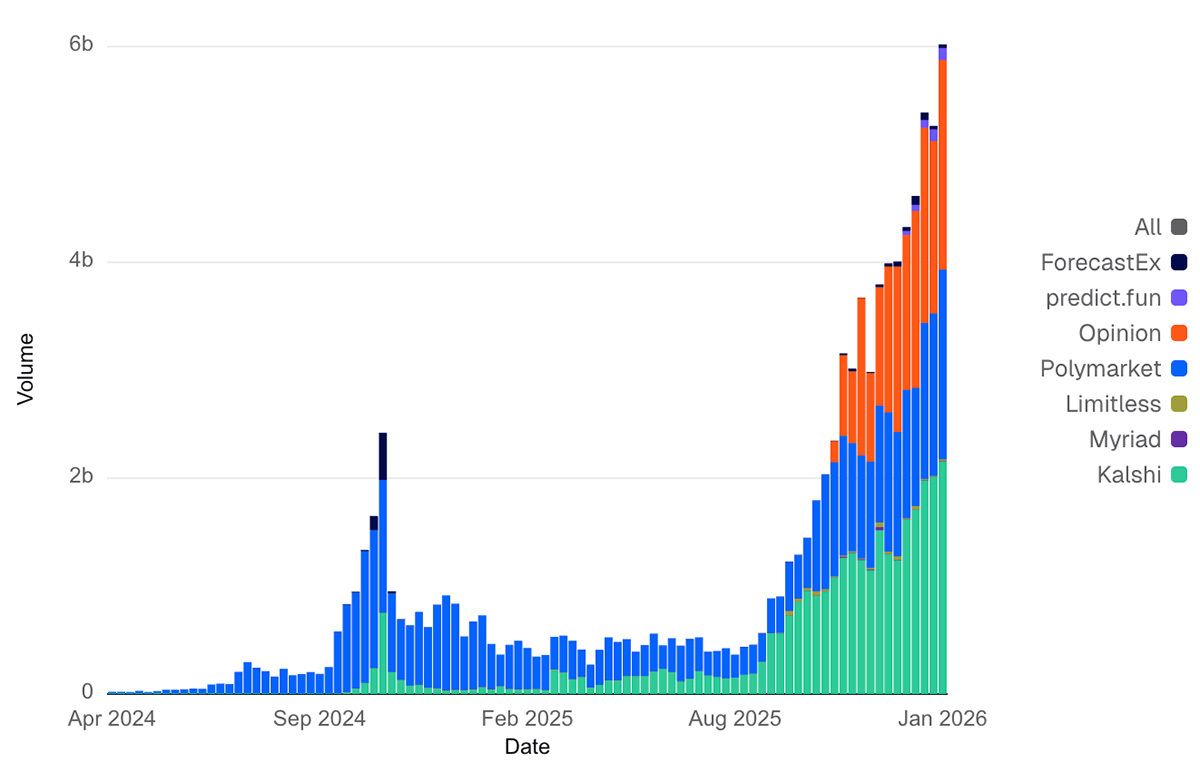
Weekly Prediction Market Notional Volume. Source: Dune Analytics
In comparison, volumes stood around $20 million per week across roughly 45,000 transactions during early April 2024.
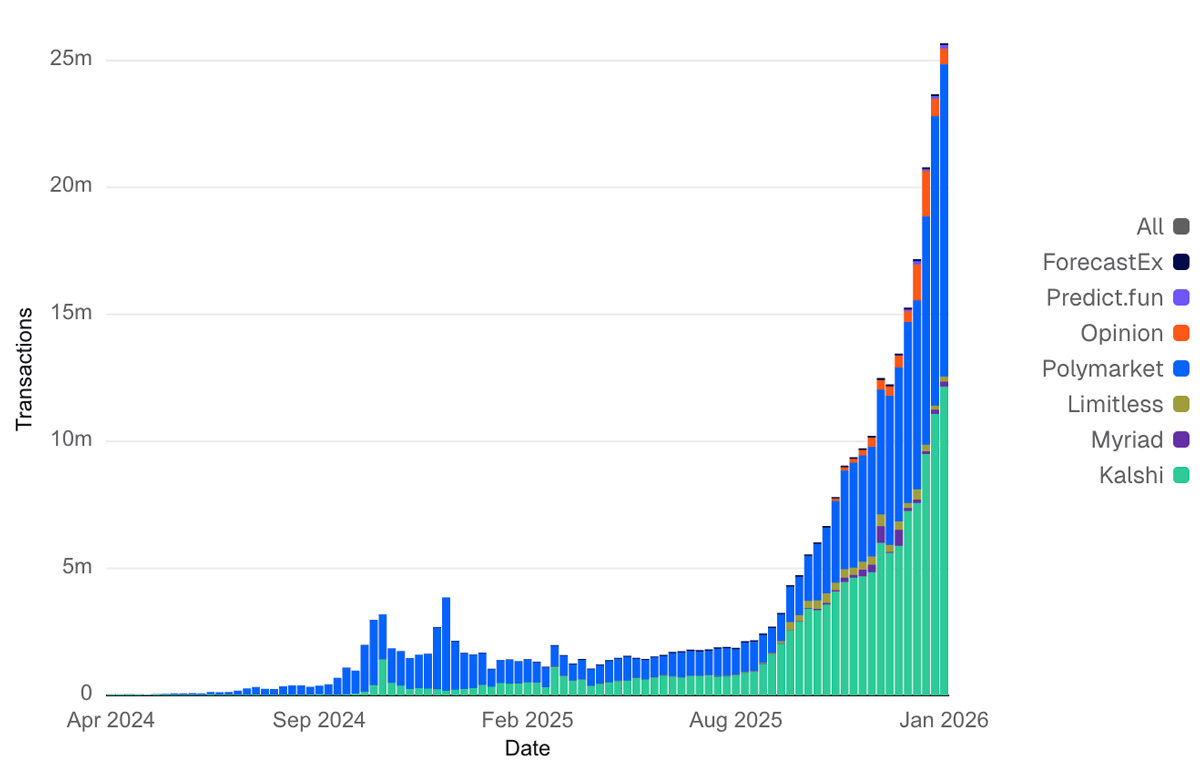
Weekly Prediction Market Transactions. Source: Dune Analytics
Event contract offerings have been available for decades under the jurisdiction of the Commodity Futures Trading Commission, notes Daniel Davis, a partner in and the co-chair for financial markets and regulation at law firm Katten Muchin Rosenman LLP.
“What you’ve seen over the past few years is an increase in the type of contracts that are being offered on CFTC markets,” Davis says. “You’ve seen expansion into the political event area, you’ve seen expansion into entertainment-related contracts … and so if you’re registered and you have your right licenses, and your products meet the requirements of the Commodity Exchange Act, they can be offered.”
Such contracts have become especially popular in recent years with the launch of Polymarket, which began offering event contract trading in 2020 but was not approved until December 2025, and Kalshi, which officially launched in 2021 and began offering regulated election contracts in late 2024.
These platforms have become a tool for information discovery, as investors gauge the probability of real-world events. For example, odds that Rick Rieder, BlackRock’s fixed-income CIO, would be selected as the next chairman of the Federal Reserve were as low as 5% on Kalshi early in January. Odds then rose to more than 45%, neck and neck with the chances that former Federal Reserve Governor Kevin Warsh would get the nod, after Rieder’s candidacy reportedly gained favor. They fell, of course, to 0% falling the announcement of Warsh as the nominee.
“As a CIO, I think of prediction market probabilities the way I think of break-even inflation, credit spreads or the yield curve—not a verdict, but useful for scenario weights as a market gauge for collective expectations, updated in real time,” says Michael Ashley Schulman, CIO of and partner in Running Point Capital Advisors. “Unlike polls, a market that forces people to put money where their mouth is can be a surprisingly good lie detector.”
While institutional investors are not directly involved in trading event contracts, they are beginning to view the market as a fast-moving indicator of political, macroeconomic and regulatory events.
“We, for years, have been following prediction markets on an ad hoc basis, such as U.S. elections [and] mid-terms, and it’s just another arrow in the quiver of getting an idea of what people are thinking,” says Thomas Garrett, managing director for strategic research at Verus. “It’s kind of semi-formal, but it gives us another way to gauge how people are thinking.”
“I think prediction markets are just kind of another tool that have recently been added to the toolkit that’s available to investors and institutional investors,” Garrett says, comparing prediction markets to traditional surveys. “[We] think about prediction markets in the same way as we think about other surveys. Surveys aren’t created equal: They all have their weaknesses and their strengths and their caveats to how they should be used.”
Garrett and other consultants have noted that prediction markets are not at the top of their clients’ minds, let alone a priority within their own firms.
The market is not without its skeptics. Event contracts offered on popular platforms are often compared to gambling, with numerous states litigating the issue.
Outsourced CIO provider Obsidian CIO LLC, in a January report, questioned the market productivity of event contracts, noting that “while prediction markets may create some value through additional forecasting data and tools, they may cause more damage to individual participants and, in our view, will not contribute meaningfully to future innovation or true economic growth.”
In breaking down a Crisil Coalition Greenwich survey of market structure specialists, Jesse Forster, a Greenwich senior analyst of market structure and technology, said, “Without depth and participation, markets may not clear efficiently enough to produce reliable signals. To win institutional trust, prediction markets must demonstrate repeatable, actionable forecasting value rather than entertainment-driven volatility.”