
Morgan Stanley’s OCIO Boss Sees Scale, Differentiation Supporting Growth
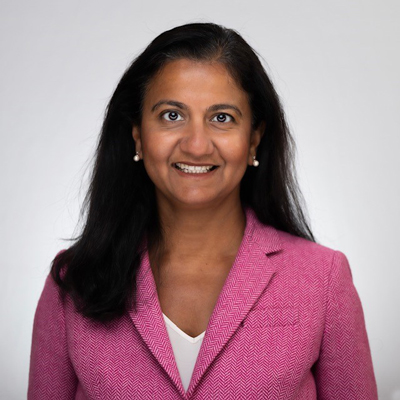
Sona Menon
Morgan Stanley Wealth Management’s outsourced CIO team, headed by Sona Menon, is seeing double-digit growth across nearly all client segments.
The firm’s OCIO platform manages assets for three client segments—retirement, endowments and foundations, and high-net-worth individuals. Menon joined the firm last March after 23 years at Cambridge Associates.
Within the retirement segment—which includes defined benefit and defined contribution plans, public plans, Taft-Hartley plans and insurers—Menon says her team has seen “seen a considerable amount of growth in [the] double digits, and it’s coming from in quite large part, defined contribution plans.”
Defined contribution plans are using investment managers with fiduciary discretion more than ever before, Menon says, as retirement plans seek lower fees. “Oftentimes through a discretionary solution, you’re going to achieve the best fee reductions, and that creates a lot of benefits for them.”
The heavy burden of regulatory duties on retirement plan fiduciaries is also a factor driving demand for OCIO services from DC plans, she adds. “Having a discretionary manager who has the time and resources to oversee that becomes incredibly important to DC plans,” Menon says. “It’s a space that’s highly litigated, and so I think that plan sponsors don’t mind having a fiduciary partner with them to oversee the plan; it reduces some of that litigation risk.”
The trend toward fiduciary outsourcing to so-called 3(38) investment managers by DC plan sponsors comes as the Department of Labor is focused on reducing litigation under the Employee Retirement Income Security Act against plan fiduciaries. In addition, the DOL last month proposed a rule for including private-market assets when selecting plan investments. Several industry observers have said adding alternative assets to plans could prompt more plan sponsors to outsource investment selection.
For these clients, MSWM offers full discretion, as well as member education and plan design support for plan sponsors, with an emphasis on cost-efficient investment vehicles and retirement income solutions.
Morgan Stanley is also finding demand for OCIO services from the insurance market. “Given the amount of interest we’re seeing, we’re actually adding more talent in that space, in our team, to support the growth of the [insurance] industry wanting to go more OCIO,” Menon says.
The firm is currently hiring a head of OCIO for insurance portfolios and a head of endowments and foundations, according to job postings from Morgan Stanley. The firm is also working to fill several other roles—both senior and junior—as part of its effort to attract emerging client segments to its OCIO platform.
Among endowments and foundations, Menon says she sees growing interest in OCIO from impact-oriented investors and faith-based organizations. Among university endowments, the complexities these institutions deal with, and the need for generating returns is leading to an increase in OCIO adoption.
Differentiation and Scale
With so many OCIO providers entering the market, Menon notes that differentiation will be particularly critical to success. “I think that one point will determine how many of these players remain five to 10 years from now,” Menon says. “The second important aspect is the ability to … deliver your services at scale.”
There are currently between 100 and as many as 134 firms providing discretionary OCIO services to various categories of asset-owners, according to data from consulting firm Chestnut Advisory and institutional recruiting firm Charles Skorina & Co. Several OCIO executives have told CIO they expect consolidation in the OCIO business over the next few years as more firms are competing for mandates than ever before. Menon says broad capabilities and being able to offer a range of services to clients will help OCIO managers to win.
Morgan Stanley aims to differentiate itself from some of the larger players in OCIO by combining scale, customization and access delivered through a high-touch service model supported by full-service infrastructure and a large distribution network supported by its financial advisers—a combination that Menon says is helping win mandates.
“As more institutions and individuals and family offices decide to go outsourced CIO… they want end-to-end services, they want a high-touch relationship, they would want a customized portfolio, they would want middle- and back-office support and they really would want an answer to any question” that comes up, Menon says. “They want reporting, etc., and being able to offer all of that at a reasonable price that would essentially help you win the business, one needs to have scale.”
“Morgan Stanley’s got an incredible presence, a significant market share of the OCIO business,” says Ravi Venkataraman, managing partner at Chestnut Advisory. “They are a significant or leading player in many of the market segments, whether it’s defined contribution, nonprofits, public plans [or] private wealth.”
Morgan Stanley’s OCIO unit benefits from its partnership with the bank’s Graystone Consulting business, itself advising on more than $700 billion in institutional assets, with Graystone serving as the key origination and coverage channel for OCIO opportunities. MSWM’s 16,000 financial advisers serve as key touchpoints for sourcing OCIO clients.
“It just speaks to the depth and breadth of not only their investment capabilities, but also their expertise and distribution network,” Venkataraman says.
MSWM takes an “adviser-front, OCIO engine” model that sees its financial advisers managing client relationships while the firm’s OCIO portfolio management teams focus on investment execution. The firm’s Graystone advisers have long-standing relationships with a number of institutional client types, and those clients can be brought into the OCIO fold when a solution needs to be discretionary.
Additionally, the firm aims to build scale through technology. Morgan Stanley has launched an AI-based solutions team to build several tools for operational efficiency.
“We have tools that are helping us standardize the look and feel of an investment policy statement document, which [have] to have certain standard components, and the non-standard components are really the investment strategy which is highly bespoke,” Menon says. “The emphasis for AI is to take what needs to get standardized and help us build efficiencies there so that we can spend more time on customizing the actual portfolio of our clients.”
Investments
For OCIO clients, the firm aims to build fully bespoke portfolios tailored to each individual client’s needs—including cash flows, liabilities, tax considerations and liquidity needs—rather than relying on model portfolios.
Morgan Stanley’s OCIO clients do have some commonalities in their portfolios—particularly in private market investments. The firm offers private investments originated by Morgan Stanley as well as by external managers through a range of structures, including direct investments, fund-of-funds and comingled vehicles.
“Clients are increasingly looking for private markets exposure, because over long periods of time, private markets will certainly pay a premium over public markets, and will very much diversify the portfolio,” Menon says. The firm sees alternatives as primary drivers of investment alpha for clients.
The firm builds out hedge fund programs for its clients seeking downside protection or diversification away from equities and bonds, Menon says, constructing an “all-weather-type hedge fund portfolio.”
Still, not all alternatives make sense for all clients. Menon notes that the firm tries to determine which particular asset classes make sense for specific clients. For example, while Menon says private credit can play an important role generating income for clients and can be a strong diversifier, it is not in all client portfolios.
Menon also highlights the importance of reminding Morgan Stanley’s clients that they are long-term investors and to help clients to see the difference between important trends and noise.
“Especially amid geopolitical uncertainty, there’s obviously a lot of conversation, and it doesn’t necessarily all need to be bad,” Menon says. “I think when markets are volatile, it can also create a lot of opportunity.”