
Gary Veerman, managing director, US client solutions, Gabriella Barschdorff, director, US client solutions, and Stephan Bassas, managing director and lead LDI portfolio manager, fixed income, talk tech changes in corporate pension de-risking with CIO’s Editor-in-Chief Kip McDaniel.
Q CIO: Let’s talk evolution of liability-driven investing (LDI). My understanding is that the conversations happening now show that clients are more knowledgeable about the topic compared to even five years ago. Is that what you’re seeing?
Veerman: I think you hit the nail on the head. Even going back almost 10 years to 2006 and the passage of the Pension Protection Act—when clients began transitioning from an asset-only framework to a liability-driven investment framework—the dialogue has evolved substantially since then. Many started with a simple move from something like a Barclays Aggregate, or a similar broad market benchmark, to long-duration government credit.
Now we’re seeing the level of sophistication increase. Clients are acknowledging their true liability: the pension benefits promised to participants. We’re talking about targeting interest-rate hedge ratios relative to liability cash flows; we’re talking credit-spread hedge ratios relative to liability cash flows given a discount rate curve. Another topic that is not new, but one that is continuing to pick up steam is pension-risk transfer. It’s the ultimate question: am I going to keep my assets and liabilities on balance sheet or am I going to try and transition them off to an insurance company?
Bassas: I agree with Gary and the trends he’s talking about. We have seen those in our clients’ portfolios. There are two simultaneous trends: a need to get more duration and also to be more explicit in hedging risk inherent in the liability. So we’ve been evolving with our clients along these paths.
We are also seeing liquidity becoming more and more of a concern, not just in corporates, but also in the rate market, as well as the idea of capital efficiency as a key consideration in implementing LDI strategies.
I do find that liquidity is not necessarily a well-understood risk, and there is confusion between the concepts of central banks, markets, and portfolio liquidity. We help a lot of our clients think through and prepare for a potential lack of liquidity, but I want to point out that we are educating them on the opportunistic aspect that liquidity—or the lack thereof—offers to pension plans.
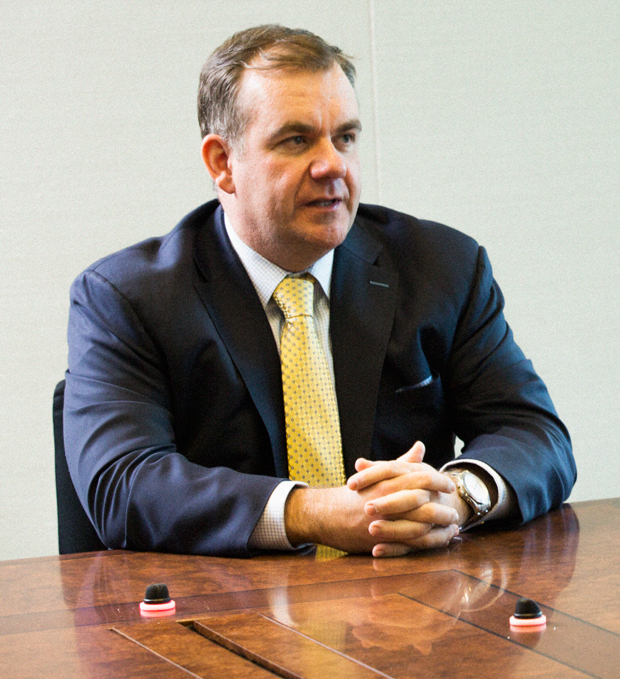 Gary Veerman
Capital efficiency, on the other end, is gaining traction not only because of the unwillingness to give up growth assets, but also because more of the instruments used for implementation are now exchange-based or centrally cleared, which improves the overall attractiveness of these options.
What is also interesting is how the majority of plans have taken a significant short duration position relative to liabilities. Plan sponsors for the most part have been waiting for a long time for rates to rise, hoping to see the funded status improve. In fact what we’ve seen over the last decade is the opposite. The vast majority of the investment community consistently forecasting higher rates, year in, year out. And here we are at less than 3% on the long bond, right ahead of the Federal Reserve preparing to exit from emergency monetary policy. This has been an issue and we are engaged with many clients on this subject. One of the key messages that we try to talk about again and again is that a Fed normalization policy is more likely to be felt at the front end of the curve, rather than pushing long yields much higher.
Credit markets are also changing. We are coming off five years of central bank-driven markets, which helped push default rates close to zero, and we saw more upgrades than downgrades. In that environment, a credit portfolio can be thought of as a very generic beta exposure. There is no real difference between a passive portfolio and an active portfolio. Now, I think we’re heading towards the end of the credit cycle. We believe—and our client base is thinking along these lines as well—it’s about credit selection now. Credit is essential to the implementation of an LDI strategy but it has to be managed according to the cycle. And now, the cycle cries for selection—in other words, picking out bond by bond and sector by sector.
Another aspect of LDI implementation that is getting more attention is the construction of the benchmark and the portfolio in general terms.
Q CIO: I know technology is a major focus for BlackRock as a whole, and an area for which it’s lauded. How do your tech capabilities and infrastructure impact what BlackRock brings to this very specific part of the market: corporate pension de-risking?
Veerman: At BlackRock, we define technology as the central nervous system utilized across all aspects of our investment management capabilities. That is a lot broader than LDI. Back in 1994, we were asked to look at a stressed mortgage book—that was our first advisory service. It was really the launching point for what we today call Aladdin, or the Asset Liability and Debt Derivatives Investment Network. BlackRock’s technology capability is clearly reflected in the $4.5 trillion of BlackRock-managed assets that rely on Aladdin, as well as in our external clients—some of the world’s largest asset owners—utilizing it in many of the same ways that we are.
On a fundamental level, think of market-based benchmarks and what Steph and others have to do every day to manage risk in that more traditional sense. Technology is so key in making sure we have accurate, real-time information to make better investment decisions for our clients.
As we move towards more sophistication in our LDI strategies—for example, a greater focus on accountability and governance, more holistic pension-risk management assignments, or explicitly managing risk vs. liability cash flows—this is where our technology differentiates us. Our systems provide not only good, clear data for portfolio managers to digest and act on, but also information that can be passed to clients very quickly. Things like hedge ratios and funded status are important, and need to be front and center when evaluating a corporate defined benefit plan’s objectives and results. Seemingly simple things like automated feeds of data coming in every day can’t be overlooked. BlackRock has hundreds of people behind the scenes ensuring data integrity. As a result, portfolio managers can do their jobs and not focus on any of the things that could distract them or worse, result in acting on bad information.
Bassas: From a practitioner’s perspective, having all data live is really crucial. When I analyze a portfolio, being able to slice and dice risk, and look at exposure reports all in one setting is paramount to the day-to-day portfolio management aspect of implementing hedge programs for pension plans.
Barschdorff: One tangible aspect that really matters to clients, for example, comes up in managing a glide path as a plan sponsor. They need to look at all their assets, equities, and fixed income, and ensure their liabilities are valued in a consistent, accurate, timely way. BlackRock’s platform is different from others in that you can actually see everything on a daily basis.
That’s not to say the funded-ratio triggers must be micromanaged from minute to minute, but if something happens intra-month or intra-quarter, you have the ability to know what occurred and react to it as appropriate. Without daily data, that’s not an option. In a quarter like the last one where there’s a lot of volatility, you can pretty easily point to an opportunity for making a strategic change in allocation based on many clients’ de-risking objectives. In other words, the technology opens the door to capitalizing on gains in funded status by removing some risk from the portfolio, or at a minimum understanding the situation and making a conscious decision not to react to it. Otherwise, investors are waiting for lots of reports from different places, aggregating, trying to reconcile it in a spreadsheet. By the time they get all the information, the situation may have changed 20 times. That’s the little more old-school way, perhaps.
Veerman: I think the point that Gabriella made is so important. We’re seeing clients continue to write funded-ratio triggers in their investment policy statements that can be acted on opportunistically as we see market volatility—like the volatility we’ve seen so far this year where funded status for some plans has swung by nearly 10%. That said, do you want to look at your 401(k) every day and drive yourself crazy? The answer is probably no, and it’s exactly the same with funded status. But if a plan hits a trigger intra-day, and has the right partner to help facilitate that transition, it can take advantage of a real opportunity that many plans might miss.
“At BlackRock, we define technology as the central nervous system utilized across all aspects of our investment management capabilities. That is a lot broader than LDI.”—Veerman
Q CIO: LDI portfolios evolve over their lifespan—indeed, by definition. What’s the role of Aladdin and BlackRock technology more broadly in managing a plan across all of these stages?
Barschdorff: It’s the fact that the system is integrated across different functions in the firm that has the real impact. Portfolio management, strategy design, and client reporting all feed off the same central repository of asset values, risk metrics, and liability data. The assets and the liabilities are visible together. We can source third-party assets and actually make them “talk” to the internal assets, and view everything combined or separate. You can simulate different outcomes, changes in asset mix or market dynamics, and it’s all coming with the same risk language and the same output.
Veerman: That’s an important point because as an industry we’ve collectively developed very inconsistent terminology. When Steph is managing a market benchmark versus the Barclays long-duration credit index, that task is generally quite similar across the 15 or 20 managers who do it. In describing liability benchmarking, five different managers will come up with five different definitions. In our mind, liability benchmarking is explicitly managing both interest-rate and credit-spread risk relative to liability cash flows at a predefined discount rate. But, importantly, we are bringing the same level of accountability to that framework as BlackRock and Steph always have in managing portfolios against more traditional market benchmarks.
Bassas: Say you have a closed and frozen plan. The duration is sliding by year, every year. With an asset benchmark there are new bond issues coming into the index, and by extension the benchmark, every year. As an example, the duration has been going up from 11 years to over 13 years on the Barclays long index from 2009 to now. So a portfolio for a frozen plan that is managed against that off-the-shelf benchmark will have an increasing mismatch, which is exactly what you don’t want in a hedging portfolio. Instead of ignoring the liability, the better way is to manage the assets against something much more bespoke to avoid lots of unintended risk.
It’s an easy exercise to analyze the profile of a liability and construct a matching portfolio that makes sense—that alone cuts a huge amount of unintended risk for little or no cost. If you have a technology platform to identify your source of risk, you don’t have to do a lot of engineering to take that important step. But every pension plan is different, and the investment manager needs the ability to model those cash flows and construct and manage an asset portfolio against them in order to achieve those risk improvements.
Veerman: You mentioned the evolution of sophistication level. We often come into contact with multi-billion dollar pension plans that have multi-manager structures. Clearly, it makes a lot of sense to have manager diversification in portfolios, particularly in the credit market, and in those cases completion management is another area that we are seeing a lot of interest in. The simple way we define it is custom liability benchmarking with a multi-manager framework. It’s about applying the same level of accountability and governance for all the managers inside and outside of BlackRock, and ensuring the risk goals are met at the total plan level. All of that comes back to the technology where, daily, we’re feeding those managers’ benchmark exposures into our tools and systems. Without technology, handling that amount of information accurately, and with the frequency required, is impossible. We are not talking about the underlying holdings at the security level—we don’t need or want to know what other managers are doing. Importantly, we would not want to offset any active positioning the third-party managers have—ultimately the plan sponsor has selected them because they believe they are going to beat the benchmark. Let them do what they do well. Let us take in their benchmarks’ information, and then implement a strategy to achieve the right interest-rate and credit-spread hedge ratios using both credit, and likely Treasuries.
“The technology opens the door to capitalizing on gains in funded status by removing some risk from the portfolio, or at a minimum understanding the situation and making a conscious decision not to react to it.”—Barschdorff
Q CIO: You’re starting to talk about derivatives, which is perfect. Let’s start with education: I assume many plan sponsors and boards are not comfortable with that word yet. What’s been your experience?
Veerman: It’s fair to say in 90 out of 100 conversations we have, plan sponsors are not focused on derivatives as a major component of their hedging portfolios. There’s been a lot of education around derivatives. But we would actually say to them, “If you can achieve your objectives through the physical market at this point, then access the physical market first.” That is just natural, as it avoids a one- to two-year education process—plus factors such as committee turnover and other externalities. Again, if you can achieve 80% to 90% of your goals in the physical market using capital efficiency with Treasury STRIPS, do it.
Q CIO: What separates the reluctant 90% from the 10% who go for the derivative strategy? Is it size? Are closed pensions more comfortable?
Veerman: There are a lot of factors. Sophistication is one and where they are along this continuum of what they’re trying to accomplish. If you’re benchmarking against 18- or 19-year liabilities, you will need to utilize derivatives to hedge a high percentage of your liabilities—there is not enough duration in the physical market and available capital in the asset portfolio is often constrained. Importantly, that should always be thought of as a risk management exercise. When we talk about liability benchmarking and completion management, there almost has to be derivative use. But that said, it could be as simple as Treasury futures—which people can get very comfortable with—or as sophisticated as utilizing swaptions to help manage specific funding outcomes that the client is looking to achieve.
Barschdorff: Presentation and communication also matter a lot. For example, we actually implement pretty sophisticated derivatives in a fund format for smaller pension plans. In these cases we focus less on the performance or behavior of each fund item and more on the role of that levered fund in hedging liabilities. We feel this lines up well with our clients’ committee meetings where we want to encourage focusing on the things that drive towards the overarching goal, which is to manage the funded ratio both from a return and risk perspective. Each of these portfolios may have four or five funds that have different leverage or different maturity points. Looking at one of those line items in isolation is going to create unnecessary attention when the plan may only be hedging 30% or 40% of their interest rate risk. They can go up and down by huge amounts every month. We present that information, but we don’t present it on page 1; we present it on page 10.
Veerman: That’s a great point.
Barschdorff: The information is there for those who want to dig in, but the exposures are really wrapped into a custom hedge portfolio that then is measured against the liability. It becomes partly a question of communication and presentation, and partly about looking at the right metrics, as opposed to the individual line item.
Veerman: The other important point that often gets lost in these conversations is where we think derivatives can help. Again, they’re not for everyone. Let’s take a plan that’s 95% funded, and moving towards 110% funded—that’s their ultimate goal. The additional benefit of increasing their funded status another dollar is not equal to the pain they suffer if their funded status falls a dollar—or said another way, funding outcomes are asymmetric. As they approach that ultimate goal, there is decreasing marginal benefit of taking risk. That’s really where you can utilize derivatives to control specific outcomes, both on the interest rate and equity sides of the equation.
 From Left: Gabriella Barschdorff; Stephan Bassas
Q CIO: Can we discuss the last big topic—pension-risk transfer (PRT)? It’s estimated there will be $11 billion or $12 billion worth of liabilities transitioned this year. What are the total corporate pension liabilities in America?
Barschdorff: It’s around $3 trillion.
Q CIO: So what does this trend—and I know it is growing—do to BlackRock’s business?
Veerman: While we build and continue to evolve our technology to help clients, we’re actually spending more and more time as a partner with them, in an advisory/transition management capacity. I’ll use one example: A client with five or six credit managers, all different sources of data, all different analytics, apples to oranges to bananas. We’re taking that data in to one place, loading it in our system, understanding the liabilities, partnering with multiple consultants involved in the transaction with the insurance companies, and finding out what the insurance company wants to ultimately hold in their asset portfolio. Over perhaps a couple of months, we’re transitioning to a portfolio that ultimately can reduce costs to the plan sponsor. It’s really this simple: if they own the bonds in their portfolios today, in-kind transfer to the insurance company will save the client money, period. Why sell bonds that are ultimately going to be repurchased by the insurance company? Especially in long credit the transaction costs can be quite large. Then, importantly, there is almost always a portfolio that is still remaining at the plan sponsor. We also helped the client make sure this portfolio was diversified and aligned with the remaining objectives.
Q CIO: Is that process where you can really add value as a firm to a plan sponsor?
Bassas: There are many steps to a PRT transaction and value to be added along the way. The area where BlackRock can really move the needle and save significant money for clients is on the execution side. If the plan terminates with assets and liabilities being transferred to an insurance company, there are actually two constituents: the plan sponsor and the plan itself. The goals of those two entities are not necessarily aligned. If you try to optimize for the lowest premium to be paid to the insurance company it will be very important to deliver a portfolio that’s attractive to the insurer. At the same time as a plan fiduciary, our job is to make sure the remaining assets are well aligned with the remaining liabilities, which may very well look quite different post-PRT. This whole process needs professional attention—and we can help all along the way, whether it’s reorganizing the assets for the best price or maximizing efficiency in the remaining portfolio relative to remaining liabilities. Pension endgames are more of a sequence throughout which we can prepare, execute, and help.
Veerman: Big picture: We think this PRT advisory/transition role for clients will grow. We’ve had eight relationships since 2014, participating to help clients move money off-balance sheet. We’ll continue to add resources, perhaps even enhancing our technology to better serve that part of the business. But we also have to remember that there is a multi-trillion dollar industry still heavily invested in risk assets. Across our spectrum of businesses, we expect asset flows into the more traditional benchmarks—like we’ve seen for a number of years—because many plans still have not moved. As Gabriella mentioned, we’re in a unique position to be able to service clients large and small. There are $50 million pension plans that want 80% to 90% of what you can do with credit-and-Treasury separate accounts, but also want the same governance and accountability. Our CTF platform is one of a kind in this respect.
Bassas: Also, pricing is not static and there are times when PRT transactions are expensive. While we think PRT is an important trend, it’s also important for us to focus on the 90-something percent of plans that are not yet in a position to do PRT, or are still open and active—a surprisingly high number in some ways. For the others, we want to be prepared for these solutions and helping them. And we’ve been helping them very actively.
This material is provided for informational purposes only and reflects BlackRock’s opinions as of October 30, 2015.
