
We are often asked, “Why do you manage risk first over return?” The answer isn’t all that complicated. As the late Benjamin Graham, arguably the father of value investing, said in groundbreaking work published in 1934, “The essence of investment management is the management of risks, not the management of returns.” Or to put a more modern spin on it, there’s this from Warren Buffett: “The first rule of investing is don’t lose money; the second rule is don’t forget Rule No. 1.”
That is why we believe in and are committed to embracing the long-term view that risk management—that is, a strategy that first seeks to limit downside risk and minimize loss—is necessary for wealth creation. Clearly, we are in good company.
The investor’s cycle of emotions looks like a roller-coaster ride To be sure, wealth management starts with portfolio diversification through effective asset allocation.
The power of this foundational principle lies in the role that compounding returns play in wealth accumulation and preservation. To that end, we see managing risk as a complement to this fundamental strategy. Mitigating large portfolio drawdowns that can occur during down periods in the markets can both reassure investors and have a significant impact on returns.
Research shows investors feel the pain of an economic loss far more than they do a gain of similar magnitude, leading them to often be underinvested after times of market corrections, undermining their potential recovery (and vice versa, i.e., to be overinvested at market tops, adding to their potential for loss). (See chart below)
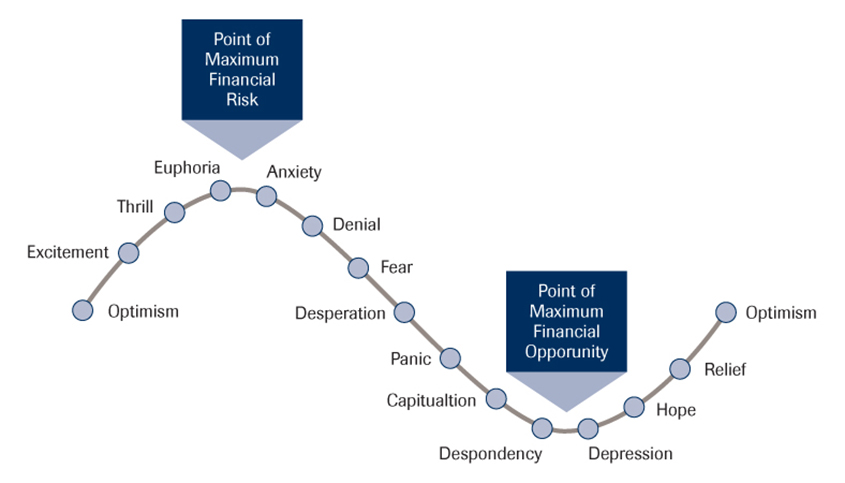
The impact on portfolios of what is commonly referred to as the investor’s cycle of emotions can be substantial as research shows it is far more important to miss the worst days than capture the best days—an outcome buy-and-hold strategies don’t follow. For example, a Ned Davis Research study of S&P 500 returns from 2000 through 2014 found that missing the 40 best days during that period would have resulted in negative annualized market return of -10.04%. On the other hand, missing only the 40 worst trading days during that period would have resulted in a positive annualized return of 17.37%.* Understanding this is critical to appreciating the benefit of adding risk managed strategies to a portfolio.
Yogi had it right As the global markets struggle with another rough period that seems eerily similar to the late-summer 2011 U.S. slowdown and the 1997-1998 Asian debt crisis, we’re reminded of the late and great baseball Hall of Famer Yogi Berra. He had it right when he said, “It’s like déjà vu all over again.” Though the trajectory over time has been up, markets never go straight up or down.
Indeed, volatility has been one of the chief characteristics of the markets over the past 15+ years, with stocks and bonds experiencing a negative daily return at least 46% of the time. As the chart below shows, this is not just a U.S. phenomenon.
% of days markets are positive from 12/31/99 – 12/31/13.

In this uncertain world, the question for investors is, which is more important as you seek to reach your long-term goals, playing defense —that is, protecting against losses—or playing offense, i.e., swinging for the fences? Perhaps a math lesson would help. If you lose 20% in one year, you will need to make 25% the next year just to break even. If you’re goal is to achieve an 8% return annually, you’ll need to earn 35.45% in the following year to offset the loss and catch up to your goal. Put another way, investors arguably should focus as much if not more on managing risk than returns. Otherwise, in times of unprecedented drawdowns, there may not be sufficient time to return to acceptable levels needed to fund their long-term goals.
For more information contact: mdieschbourg@federatedinv.com
*Data from 2000-2004. Past performance is no guarantee of future results. Indexes are unmanaged and investments cannot be made in an index. For illustrative purposes only and not representative of performance for any specific investment.
Alternative investing, including use of futures and short positions, may involve risks different from or possibly greater than the risks associated with investing directly in securities and other traditional investments.
Q452916 (11/15)
Federated is a registered trademark of Federated Investors, Inc.
Federated Equity Management Co. of Pennsylvania
2015 ©Federated Investors, Inc.
