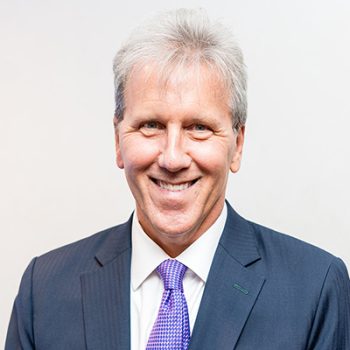

Operating two public pension funds with two CIOs and essentially a single investment team is one of the many ways that two Fairfax County (Va.) portfolios, totaling approximately $7 billion, work to be as efficient as possible.
Katherine Molnar, of the $2 billion Fairfax County Police Officers Retirement System, the oldest of Fairfax County’s retirement systems, and Andrew Spellar, of the $5 billion Fairfax County Employees’ Retirement System, were recognized as the winners of the Industry Innovation Award for public defined benefit plans with less than $25 billion in assets because they do things differently.
“Our trustees acknowledge we are going to look different than our peers,” Molnar says.
“But we create a portfolio that beats cash 60% to 65% of the time,” Spellar says. “Consistency of returns is what matters.”
Molnar says, “We are thoughtful about the most cost-effective way to gain every exposure we hold—electing to be passive in certain efficient asset classes—such as S&P 500, U.S. Treasurys, commodities—via futures, which frees up capital to deploy to less-efficient asset classes.”
Their portfolios use leverage to add value and to gain exposures to a range of asset classes in a way that contributes to an efficient use of cash.
“The prudent use of modest portfolio-level leverage deployed to diversifying strategies allows us to run with higher notional exposures than many of our peers—yet lower realized risk,” Molnar says.
Spellar describes it this way: “The whole plans [are] a portable alpha construct,” he says, adding that it conceptually follows the all-weather portfolio as used by Bridgewater Associates, a manager for both systems.
The plans’ investment model, overall, is more like an endowment model that Spellar says has accessed “a little less volatility, but we don’t give up return.”
The plans have a 6.75% assumed rate of return, are nearly 80% funded and report annualized returns, net of fees, for one, five and 10 years of 10.68%, 6.10% and 5.98%, respectively.
In the last two years, Molnar and Spellar have been working to complete the buildout of both a barbelled private equity portfolio and a highly uncorrelated private real asset portfolio.
Molnar describes the private equity allocation as bifurcated into general partner strategies and smaller, niche strategies. The GP stakes strategy purchases minority equity stakes in the general partnerships of private equity, private credit and private real assets managers and enables the pension funds to participate in the fees and carry the firms earn as owners of larger broad market private equity firms. At the other end of the barbell, “we have invested in small funds in niche … categories such as blockchain technology, artificial intelligence, life sciences and cyber/national security,” she says.
The private real asset portfolio is a collection of strategies such as electric vehicles, rail cars, cattle feedlots, grain elevators, natural gas assets, metals merchanting businesses, music royalties and broadband capacity, according to the pair.
Innovation in recent years has come from relatively small venture capital investments in the digital assets sector, beginning in 2018, that have “far exceeded our expectations to date, even with the recent volatility in those markets,” Molnar says, adding that “a relatively small allocation to yield farming in the digital space has recently been added to the credit/fixed-income portfolio as a high-yield replacement.”
The innovation they point to involves “understanding risk contribution and risk allocation versus capital allocation in portfolio construction,” Molnar says. “All positions are sized based on their risk contribution. … Appreciating that cross-asset correlations aren’t static, we don’t rely on historical correlations in our portfolio construction process. Rather, we strive to be diversified across the economic cycles (of rising growth, falling growth, rising inflation and falling inflation) and business cycles (expansion, peak, contraction and trough). These innovative, capital-efficient portfolio construction techniques differentiate us from most of our public pension peers.”
—Amy Resnick
Public Defined Benefit <$25B Finalists
- SSM Health
Ted Hall - Orange County Employees Retirement System
Molly Murphy - Employees’ Retirement System of the State of Hawaii
Kristin Varela
-
W.K. Kellogg Foundation
Carlos Rangel Collaboration
 -
RTX Corp.
Robin Diamonte Corporate Plans
 -
CIO of the YearUniversity of Illinois System
Geri Melchiorre Endowments
 -
Joyce Foundation
Nickol Hackett Foundations
 -
Indiana University Health
Josh Rabuck Health Care/Hospital Plans
 -
Fairfax County Police Officers Retirement System and Fairfax County Employees’ Retirement System
Katherine Molnar and Andrew Spellar Public Defined Benefit <$25B
 -
The Public School and Education Employee Retirement Systems of Missouri
Craig Husting Public Defined Benefit >$25B
 -
Texas Municipal Retirement System
Yup Kim Public Defined Contribution
 -
Lifetime Achievement AwardMaryland State Retirement and Pension System
Andrew Palmer
-
Versatility AwardCleveland Clinic Investment Office
Stefan Strein