
How a Chinese Takeover of Taiwan Would Affect Investments
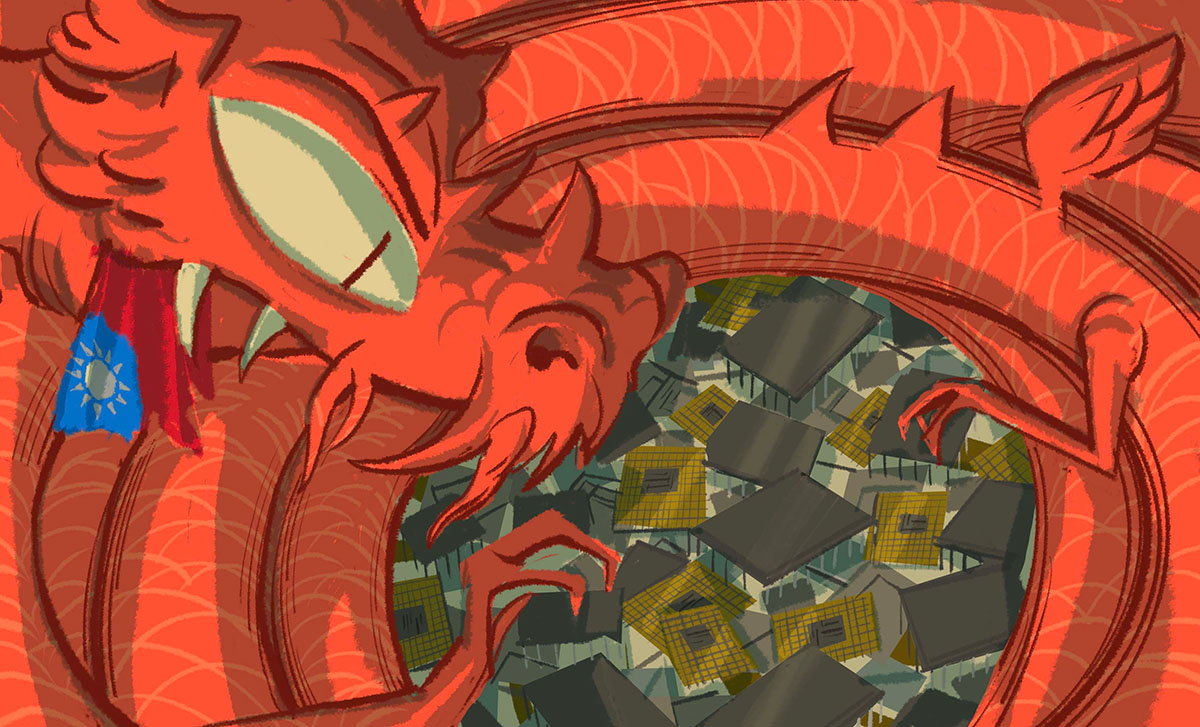
Art by A. Richard Allen
As if investors don’t have enough to worry about. World War III, pitting the US against China? Bloody naval battles in the South China Sea? Beijing’s domination of the world’s semiconductor supply? Worldwide economic cataclysm? Even a nuclear holocaust? All these dire scenarios swirl around China’s escalating threats to gain control of Taiwan.
The big question is whether the Beijing regime would risk the economic consequences of military conquest. Assuming control of Taiwan’s vaunted tech industry, in particular its chip production, might turn out to be an empty victory for China, ostracizing it from much of the world. And the post-hostilities chip fabrication plants, or fabs, might be too trashed to be useful. Such considerations might deter China from actually invading, noted Cameron Brandt, EPFR’s research director, adding, “The Chinese government is pragmatic.”
On the other hand, China could turn to an incremental strategy, much as it did with Hong Kong, which the British in 1997 ceded to Beijing. China’s leaders pledged to allow the city to retain its autonomy and free-market system. In recent years, though, China eroded those protections and now has complete command over the place. Some investors are wondering whether such a tack would be successful for the Chinese rulers in their quest for Taiwan.
Public opinion in Taiwan is heavily in favor of continued independence. Said Tsai Ing-wen, the Taiwanese president, “There should be absolutely no illusions that the Taiwanese people will bow to pressure.” At the moment, the island’s stock market is doing well, up this year just under 20%, implying that investors don’t think hostilities are imminent.
Would an invasion be successful, would a takeover even be economically worthwhile, and is a more sly, Hong Kong-style strategy China’s best bet?
Invasion: D-Day or Disaster?
In 1949, Mao Zedong’s Communist Party defeated the nation’s pro-Western government, which fled to Taiwan, 80 miles off mainland China’s coast. Since then, China’s Marxist hegemony has thirsted to annex Taiwan, a capitalist democracy with a thriving economy.
Lately, the Beijing regime has escalated its rhetoric. Chinese President Xi Jinping recently declared: “The historical task of the complete reunification of the motherland must be fulfilled.” To punctuate that, China’s fighter jets have crossed into Taiwan’s air defense identification zone. Xi doesn’t seem to care that much of the world abhors these actions—and may well cut trade with the Chinese should it make good on its martial threats.
The mainland’s armed forces are far larger than Taiwan’s. The Stockholm International Peace Research Institute (SIPRI) estimates that China spends about 25 times more on its military. According to the Pentagon, the Chinese People’s Liberation Army (PLA) has 975,000 troops, versus 88,000 for Taiwan. The mainland’s naval forces are far more numerous, and Taiwan has about two-thirds as many fighter aircraft as China does.
Xi has demonstrated no hesitancy about taking aggressive action on territorial disputes. Despite international condemnation, he violently squashed Hong Kong’s pro-democracy movement, militarized contested islets in the South China Sea, and established forced re-education camps for 1 million Muslim Uighurs in Xinjiang.
A D-Day style invasion of Taiwan is a much more difficult operation, though, strategic experts say. D-Day was successful against Nazi Germany, albeit barely. “Amphibious landings are hard to pull off, and need three-to-one” China-to-Taiwan troop levels, Brandt said. And the invading troops, he added, “have to be very well trained.” The problem for the PLA is that much of Taiwan’s coastline is rugged and the surrounding waters are rough, meaning not a lot of beachfront is available for a significant landing.
The extent of American involvement is difficult to gauge. Taiwan has a commitment from the US dating back to the 1954 Sino-American Mutual Defense Treaty. The US has reiterated its position that it will stand by Taiwan, but no one is clear if that means the American military will be deployed to stop a Chinese incursion or will simply give the island more arms.
Secretary of State Antony Blinken told Reuters that an invasion would bring “terrible consequences,” repeating President Joe Biden’s assertion that Washington will support Taiwan if it is invaded. Despite the US’s large power projection capabilities, uncertainty surrounds the ability to mobilize enough American forces to get to Taiwan in time to repel the invaders. The closest US military base is on Okinawa, Japan, 400 miles from Taipei, the Taiwanese capital. Beyond that, the larger risk of such a military confrontation is that it could escalate into a nuclear exchange.
Beijing bitterly remembers the last—and only—time it faced America in combat, during the Korean War: President Dwight D. Eisenhower coerced China into negotiating an end to the conflict by vowing to use atomic weapons against Chinese targets if it did not come to the table. Now, China has its own nukes.
That, however, doesn’t necessarily make the regime eager to use them, knowing that its carefully constructed economy, now the world’s second largest, could be destroyed by the daunting US nuclear arsenal. Such is the hope, anyway. As many military experts have cautioned, in the heat of an armed conflict, catastrophic misjudgments are not rare.
The Semiconductor Factor
Taiwan’s chip makers are the biggest on earth and a key part of the island’s gross domestic product (GDP). Taiwan Semiconductor Manufacturing Company (TMSC) is the champ here. If Beijing brought the chip makers under its aegis, then Xi and his bunch could dictate to the rest of the world like the Organization of the Petroleum Exporting Countries (OPEC) used to do with oil in the 1970s. Some also fear that China-owned chips might be laden with malware and spyware to undermine the West.
The problem for China is that, once its soldiers took over Taiwan, the tech infrastructure might be rendered useless. “Taiwan could destroy those foundries and make a takeover moot,” said Stuart Katz, who as CIO of Robertson Stephens studies China. That’s one reason, he continued, “it’s in China’s best interest to stay within the guardrails” and not invade.
Taiwan chip sabotage wouldn’t just hurt China. If Taiwan’s chips should vanish from the market, their loss “would immediately devastate the global economy,” wrote celebrated tech analyst Jon Stokes in a report. “An unknowable number of large companies just wouldn’t be able to refill their inventories for an indeterminately long time.”
That would make the current shortfall of chips seem like a cornucopia. Very few semiconductors would be available for iPhones, workstations, game consoles, automobiles, airplanes, and supercomputers, to mention just a few of the electronic devices civilization depends upon today.
The extent of the damage from a chip vacuum would be incalculable, Stokes warned. “It’s hard to say where TSMC’s chips are sprinkled throughout the global supply chain. But my guess is it would be very grim.”
Hong Kong and Sun Tzu
China took two decades to complete the subjugation of the city that has been the premier Asian financial center under the British Crown. The British, who had assumed rulership of Hong Kong in 1842 after China’s defeat in the First Opium War, thought in 1997 that they had sealed the city’s status as a standalone region within the People’s Republic of China (PRC). And, for a while, that situation was true.
Sun Tzu, the fifth century Chinese philosopher who wrote The Art of War, counseled that patience often was a warrior’s best weapon. That advice worked with Hong Kong.
Since 1997, Beijing chipped away at the territory’s freedoms, and over the past year used a crackdown on mass protests to end Hong Kong’s autonomy. In 2020, Beijing bypassed Hong Kong’s legislature and imposed new restrictions on the city, criminalizing any dissent. It also approved broad definitions of terrorism and took over the judiciary to ensure the national government’s edicts were obeyed. The new mainland-controlled local authorities arrested activists and newspaper editors, fired city workers, rewrote school curriculums, and seized assets from people the powers-that-be disliked.
What’s unknown is whether Xi has the patience to play a Hong Kong-type long game vis-à-vis Taiwan. His moves in recent times seem to show a man in a hurry.
To be sure, there are crucial differences between Hong Kong and Taiwan. The British handover allowed the Chinese leadership a role in the city’s governance, a base it ably employed to slowly spread its power. Beijing has no such foothold in Taiwan.
Still, that’s not to say the PRC, if it bides its time, can’t inveigle its way into a more prominent position to influence life on the island. Emily de La Bruyere, a co-founder of Horizon Advisory and a China expert, believes that the regime “will much prefer the Hong Kong approach.” She pointed out that Taiwan already has extensive production facilities and business dealings with the mainland. As such, China could gradually gain control over key Taiwanese industries, in particular tech. “Taiwan depends on China,” she observed.
A common conviction among many economists and foreign policy experts is that China’s economy, and thus its influence on world affairs, eventually will eclipse the US. Should that happen, it makes sense that China increasingly will be able to get what it wants. Under that scenario, Taiwan’s days of sovereignty may be many, yet in the end, will run out.
Related Stories:
Broken China? Maybe Things Aren’t So Bad
Investors’ Dilemma: Buy Stocks in Growing China, or Not?
Cathie Wood Cuts China Stock Holdings, Leery of Beijing’s Crackdown