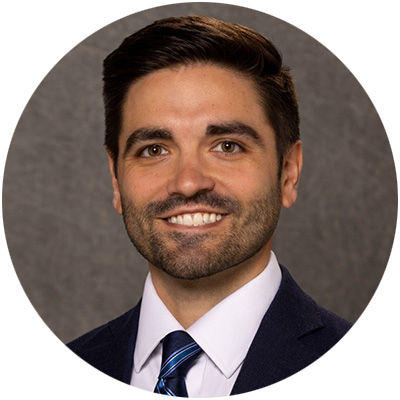

“Eric is a great strategic thinker and has added value across our portfolio!”
—Lisa Murray, CIO, Ewing Marion Kauffman Foundation
The CHIEF INVESTMENT OFFICER Editorial Team shared a dozen questions with all our NextGen nominees and asked them each to pick six to answer. Their answers informed our decision to include them as a NextGen. Below are Eric Levene’s answers.
CIO: How are you dealing with interest-rate risk and market volatility?
Levene: The foundation’s portfolio has been fairly well-insulated from interest-rate risk, having had no fixed-income exposure since the global financial crisis. The residual cash we do carry is invested in a money market fund, the higher yield of which has been a welcome benefit in a market environment rife with risk. To mitigate the impact of volatility, we adhere to a long-term approach and do not shift exposures tactically. With a high strategic allocation to equities (about 75%), we know our mark-to-market losses may be severe over shorter periods, but we believe the portfolio is well positioned to mitigate the permanent impairment of capital—our preferred risk gauge—and to deliver attractive returns over the long term.
CIO: What is the best way to bring more diversity to the financial industry?
Levene: The best way to bring more diversity to the financial industry is by engaging with folks at all levels of professional development while being very intentional about combating implicit bias in the hiring process. The more we, as financial professionals, can leave a positive impact on those finding their path, like students and young professionals, the more we can expect to see a more diverse industry workforce.
As institutional allocators, we can also impact change through allocation decisions. For our team, this has meant engaging in open and honest conversations with our prospective and existing managers to understand how they seek to encourage diversity, both internally and externally. We believe that diverse teams drive better investment results, and we seek to partner with those who embrace and encourage a variety of perspectives.
CIO: What asset classes offer the best options for avoiding or mitigating drawdown risk in an institutional portfolio?
Levene: Long/short equity hedge funds with strong risk management frameworks can help insulate investors from equity-market levels of volatility and help reduce downside participation. Those with a demonstrably low beta to the equity market and focus on consistent return generation are best positioned. Additionally, broad alternative credit strategies can generate consistent double-digit returns with minimal drawdown risk. I think solutions-based strategies managed by best-in-class GPs are particularly attractive in the current market environment.
CIO: What asset class or investment troubles you most right now, and why?
Levene: As a U.S.-based institution, the asset class most “keeping me up at night” has been our allocation to international equities. The foundation has long taken a global approach to investment management, which we believe can enable performance in a variety of market environments. Having said that, the recent market cycle has been dominated by growth in U.S. corporates, and our weight to non-U.S. stocks has proven a headwind. We know that over long periods, the relative performance of global equity indices is not linear and changes over time. It’s why we’ve long believed in the benefits of global diversification. The first half of 2025 has been a welcome reprieve for investors in non-U.S. equities, and the ongoing valuation advantage they maintain over U.S. equities could continue to favor underweighting the U.S. We continue to believe that, over time, we should be rewarded for maintaining a disciplined approach to risk management and diversification, but it has troubled us, given the level of concentration driving market performance and the magnitude of advantage that U.S. stocks have enjoyed in recent years.
CIO: Who in asset management (a person, not a firm) has most influenced your growth as an institutional asset manager?
Levene: I have been incredibly fortunate to work with some of the utmost professional allocators throughout my career who have influenced my professional growth. Lisa Murray, the foundation’s chief investment officer, in particular, has been a constant supporter, whose trust, openness and accessibility have helped me develop the skills and temperament to be a successful institutional allocator. I’ve also learned so much from current and former colleagues Diane Mulcahy, Brian Scharf and Mary McLean, and I am grateful to have learned and to continue to learn from each of their unique perspectives on life and markets.
CIO: What new skills do you think allocators or institutional investment teams need to be leaders in the field in the coming decade?
Levene: I think the most important skills for investment leadership in the coming decade are not so new, but rather timeless and invaluable: a deep curiosity to look under stones left unturned; a strong emotional intelligence to weather market cycles; and a decisionmaking framework based on probabilistic thinking. Humility and the ability to admit when you’re wrong are paramount, and a healthy dose of skepticism or willingness to be a contrarian can help, too.