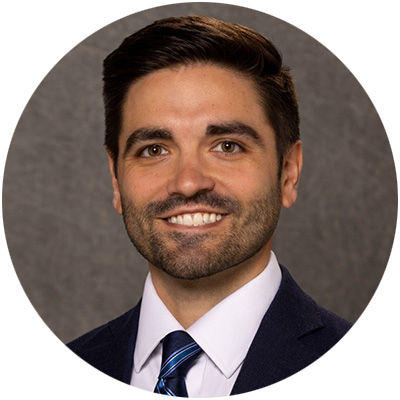

“Brett is one of the most diligent and forward-thinking investment analysts I have ever worked with. By skillfully navigating multiple asset classes and a wide array of projects every day, he has a tremendous impact on the defined benefit portfolio and defined contribution lineup for our members. Brett has quickly established himself as a next generation leader in the investment industry, and we are fortunate to have him as a teammate at INPRS.”
—Scott Davis, CIO, Indiana Public Retirement System
The CHIEF INVESTMENT OFFICER Editorial Team shared a dozen questions with all our NextGen nominees and asked them each to pick six to answer. Their answers informed our decision to include them as a NextGen. Below are Brett Stoughton’s answers.
CIO: Who in asset management (a person, not a firm) has most influenced your growth as an institutional asset manager?
Stoughton: David Stelsel (a NextGen alum) was my supervisor when I joined INPRS. On my first deliverable, there was so much red ink all over, that I questioned if I did any of it right.
David’s diligence as my manager pushed me to evaluate and question everything, but to then always synthesize to the most important items and tangible value-adds for my stakeholder or audience. AI helps individuals synthesize large amounts of data, but I doubt it will ever be 100% correct 100% of the time. Doing the grunt work matters. Details and footnotes matter. Exploring the rabbit holes matter. Robust research and analysis by an asset allocator build confidence and trust with a portfolio’s trustees or clients to know that 100 appendix slides back up that single executive summary slide (actually or theoretically).
Today, David asks me to provide feedback on his items, even though I don’t work directly with him anymore. I’ll admit that there is some joy in avenging my first red ink-saturated report. But he trusts me to be candid with him, and I trust him to be candid with me. That way, our members and beneficiaries win.
CIO: How can allocators address the growing global headwinds of demographics, geopolitical tensions, trade wars and changing supply chains?
Stoughton: The future is uncertain. It always has been, and it always will be. No one can truly know how demographics, geopolitical tensions, trade wars and changing supply chains will exactly unfold and their subsequent impacts on markets. But what is knowable is that their portfolio impacts will likely ebb and flow over time, over both short- and long-term time spans, through positive and negative ways, and across entire markets vs. individual assets. Unless one is either 1) equipped to monitor all economic-noteworthy news items at all times and can rebalance quickly or 2) one has an extremely long time horizon with little to no outflows, an asset allocator should balance their investment risk against potential economic regimes, notably changes in growth and inflation.
This likely means devoting more attention to geographic diversification, and most asset allocators currently do today. Geographically, there will be winners and losers in each development between countries, asset classes, sectors and individual securities. Therefore, maintain diversification to harvest as many uncorrelated risk premiums as possible.
CIO: What asset classes offer the best options for avoiding or mitigating drawdown risk in an institutional portfolio?
Stoughton: A futures-based commodities strategy can help a diversified portfolio take advantage of buying into drawdowns of other asset classes, especially precious metals and certain agricultural products for growth scares that hurt equities, and energy and industrial metals for rising growth/inflation that could hinder bonds.
However, I, personally, don’t believe commodities generate sufficient returns for most asset allocator targets on a stand-alone basis over the long term. This is because commodity prices should be reflective of the inflation rate of the real economy (goods), yet most asset allocators have higher return targets than inflation.
If the stand-alone commodities asset class isn’t expected to hit the return target on its own, asset allocators can employ two strategies to improve aggregate portfolio performance. During down times (potentially long periods), investors should consider mitigating the cost of carry to reduce portfolio drag. Then in times when commodity prices surge (e.g., geopolitical instability), rebalance that appreciation into the other asset classes that have depreciated.
CIO: What new skills do you think allocators or institutional investment teams need to be leaders in the field in the coming decade?
Stoughton: The growth in defined contribution plans will require many investment professionals to learn and apply 1) behavioral finance and 2) sequence of return risk to portfolios in a much more sophisticated manner than ever before. Defined benefit plans have usually been accompanied by investment and actuarial teams to carefully match the one unique, but relatively controlled, asset-liability stream of the aggregate plan. But DC plans have individual participants with their own unique situation.
For example, employer-sponsored DC plan QDIAs have largely been built around balance accumulation. Participants with at least 20 years until retirement can largely set it and forget it with a growth-biased portfolio. But the investment industry must still explore and craft decumulation QDIA strategies that participants nearing or in retirement can understand and successfully leverage. DB plans move slowly, but individual DC participants’ portfolios will one day abruptly shift from a relatively stable and slightly positive cash flow stream to a relatively variable and highly negative cash flow stream (e.g., for INPRS DC participants, that could be a swing from 3% payroll contributions to 4% balance withdrawals). Asset allocators need to balance an adequate return target, negative skew, high kurtosis, flexibility and liquidity.
CIO: What roles do AI and large language models play in institutional investing?
Stoughton: The rise of DC employer-sponsored plans has shifted the investment burden from investment teams to the masses. But not everyone is an investment expert or can seek professional help. So the DC industry has largely used target-date funds as a one-stop solution for their employee base to obtain generally prudent risk/return portfolios through their lifetimes. But even a TDF glide path that is carefully crafted for a specific plan’s unique employee population may not be the exact perfect solution for any one individual participant of that plan. Every individual has unique characteristics that could impact their future cash flow needs, which should influence how to manage one’s portfolio (specific retirement age, Social Security filing, marital status, family needs, health, standard of living, non-employer retirement plan assets, tax situation, location, etc.).
Managed accounts were the initial effort to group participants into certain model portfolios. But not even these solutions consider everything that might be prudent. While not ready yet, especially from a security perspective, I think AI applications of participant information will play a major role in the future of institutional investing. The future seems to be DC. And the future seems to include AI. It makes sense that these will eventually converge.
CIO: How are you dealing with interest-rate risk and market volatility?
Stoughton: Managing interest rate risk is hard. Particularly when interest rates go up, this means assets have higher discount rates, lowering their present value. Few assets can escape this fundamental dynamic. Our institutional portfolio tries to diversify into a few things that can mitigate interest rate volatility, such as floating rate public and private debt, short-duration fixed income and absolute return strategies. Such asset classes can offset the likely drawdowns in fixed-rate debt, equities and real assets in times of rising interest rates, whereby falling interest rates will cause the inverse relationship.
For market volatility, it is important for asset allocators to consider risk allocations in portfolios. A global “60/40” will exude way more equity risk than bond risk, far more than what such a relatively balanced portfolio on a capital allocation basis might seem to have. Therefore, develop the most diversified portfolio possible that is still expected to meet your return target and rebalance through times of market volatility. Even if (equity) market volatility takes years to recover, even marginally rebalancing to buy the (equity) dip can help improve the future expected return.