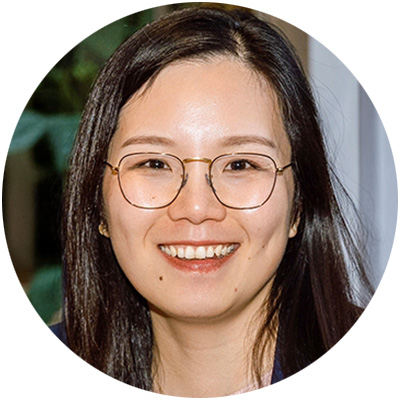
“Jinwen Chen combines intellectual curiosity with a drive and determination that has enabled her to be a top contributor to the team and to achieve impact on the portfolio. Beginning at the Smithsonian as a student intern in 2012, she has continually risen within the organization from her start as an operations analyst to becoming director of investments in 2022. She commands a comprehensive knowledge of investment management and processes, performance and analytics. She has been instrumental in meeting the high demands of the Smithsonian endowment and has contributed to its top rankings over the last five years.
“Jinwen is an incredibly thoughtful, proactive and talented individual who continues to increase her knowledge and expertise. She possesses multiple credentials that include CFA, MBA, CPA and a financial engineering degree from a top-ranked school in China. But it is her managerial capability, combined with her emotional IQ, that has been the linchpin to her success. She is a thoughtful and responsive supervisor and mentor. She is a consistent star within the Smithsonian investment team and has been recognized as an industry leader by her multiple speaking engagements. She adopted new technologies to increase our efficiency and productivity and spearheaded brainstorming discussions that led to novel research themes and landscapes. She sourced, diligenced and recommended private/public investments that made improvements to private equity, venture capital and real estate portfolios. She is deeply committed to excellence.
“For these reasons and many more, I strongly support Jinwen’s nomination, for she embodies the integrity, discipline and impact that should define a leader.”
—Amy Chen, CIO, Smithsonian Institution
The CHIEF INVESTMENT OFFICER Editorial Team shared a dozen questions with all our NextGen nominees and asked them each to pick six to answer. Their answers informed our decision to include them as a NextGen. Below are Jinwen Chen’s answers.
CIO: How are you dealing with interest-rate risk and market volatility?
Chen: We’re looking at interest rate risk and market volatility as signs of a real regime shift. Like Howard Marks indicated in his “Sea Change” memo, the era of free money is over. One thing we learned from the last cycle is that leverage cuts both ways—so we’ve been cautious about managers who lean too heavily on it. Instead, we’re focusing on GPs who can drive value through real operational improvements or have a repeatable edge beyond just financial engineering.
As for opportunities, our first step has been to rethink portfolio construction from a clean slate in this new environment. Since 2020, volatility has become more persistent, so we’ve leaned into optionality—things like cash-generating assets such as bridge lending and distressed credit—and adding tail hedges that can pay off in stress scenarios. At the same time, we’re still committing across vintages to retain exposure to long-term growth. In essence, allocation policy is very important to keep us disciplined while exploring flexible ways to rebalance.
CIO: What asset classes offer the best options for avoiding or mitigating drawdown risk in an institutional portfolio?
Chen: That’s a great question—and to me, it really speaks to how investors can construct and manage a portfolio to achieve targeted risk-adjusted returns over time. Over the past three years, private equity and venture capital have seen significant markdowns, which caused many institutional portfolios with heavy exposure to underperform both the broader market and some passive portfolios. But if you zoom out and look at a longer time horizon, those same asset classes have often been key drivers of outperformance.
Rather than viewing specific asset classes as the main source of downside protection, I believe the focus should be on building a well-diversified portfolio with uncorrelated or low-correlation sources of risk and return. That approach is far more effective at mitigating large drawdowns than relying too heavily on fixed income—which hasn’t always held up, as we saw with the Treasury sell-off in April.
Ultimately, manager selection and alignment of interests matter more than asset labels. An over-leveraged real estate manager won’t protect you in a rising rate environment—regardless of the asset class.
CIO: What roles do AI and large language models play in institutional investing?
Chen: In the short term, AI and large language models are already improving efficiency across institutional investing by streamlining data aggregation, automating document review and enabling faster, deeper analysis. Tasks like scraping fund documents, reviewing manager letters or monitoring portfolio company news can now be done in a cost-efficient way.
Over the long term, I think that AI has the potential to structurally reduce market inefficiencies—particularly in private markets, where information asymmetry has historically been a key edge. As proprietary data become more standardized and accessible through AI-driven tools, the playing field may begin to level. This could fundamentally alter sourcing, due diligence and even pricing, especially in data-rich strategies like real estate or secondaries.
However, capturing this potential will depend on access to robust data infrastructure. Larger institutions with the scale to invest in systems and talent may gain a persistent advantage.
CIO: What should be an investment trend, but isn’t (yet)?
Chen: Independent sponsor deals. I’ve spent a fair amount of time with lower-middle-market buyout managers, and I’m often struck by how successful some emerging managers have been in executing pre-fund deals, albeit with the usual survivorship bias. Many of those standout transactions were independent sponsor deals. They come with several advantages compared with traditional private equity fund structures: LPs can evaluate and select individual deals, there are no fees on uncommitted capital, there’s no obligation to lock up capital in a 10-year vehicle, and LP can build a bespoke structure to be better aligned.
That said, these opportunities present real challenges for smaller institutions. Without a deep bench or a dedicated deal team, it’s difficult to systematically underwrite and execute in the short/demanding. Decisionmaking has to be fast and conviction-driven, which isn’t always compatible with lean teams or committee-driven governance. On the GP side, many independent sponsors ultimately want to transition out of the deal-by-deal lifestyle—especially given how tough the fundraising environment has become. Still, for investors with the right capabilities, this space holds overlooked potential for differentiated access and alpha.
CIO: What investing decision have you made for your organization that you’re most proud of?
Chen: I’d have to say one of the decisions I’m most proud of is the secondary sale of our VC fund interests in late 2021. At the time, we were monitoring a significant overweight to venture capital following the historic run-up during the 2021 VC boom. As a team, we spent time evaluating different rebalancing options and ultimately decided that a secondary sale was the most effective way to realign the portfolio. Looking back, it was a valuable experience—not just in terms of financial outcome, but in demonstrating that sticking to your strategic asset allocation and acting decisively, even in strong markets, is key to long-term success.
CIO: Who in asset management (a person, not a firm) has most influenced your growth as an institutional asset manager?
Chen: That’s a tough question—it’s hard to pick just one person who’s influenced me the most. I’ve found that human nature and luck often play big roles in people’s successes. But if I had to name someone, I’d say Don Valentine. Back in the 1970s, he really helped shape the modern venture capital model after Arthur Rock. At the time, the idea of power-law investing and the massive impact computers would have on society wasn’t widely accepted. Valentine saw what others didn’t—he made bold bets on Atari, Apple and Cisco, and built Sequoia into the giant it is today. What stands out to me is not just his foresight, but his conviction to act on it, even when the consensus wasn’t there. That mindset—seeing the world a little differently and backing it with action—has stuck with me.