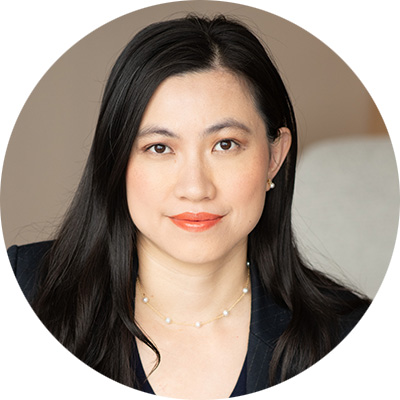
“Helen Huang is a truly deserving nominee. Helen has been the driving force behind the reinvigoration of MassPRIM’s venture capital program, bringing intellectual rigor, deep market relationships and creative dealmaking to one of the most competitive corners of institutional private equity. Her combination of LP and GP experience—spanning Summit Partners, Harvard Management Co. and China Growth Capital—gives her a rare ability to see the market through multiple lenses, which she channels into investment process innovation and delivering performance.”
—Michael McGirr, CIO, MassPRIM
The CHIEF INVESTMENT OFFICER Editorial Team shared a dozen questions with all our NextGen nominees and asked them each to pick six to answer. Their answers informed our decision to include them as a NextGen. Below are Helen Huang’s answers.
CIO: What is the best way to bring more diversity to the financial industry?
Huang: Having spent time on both GP and LP sides, I’ve seen firms that successfully bring diversity with intentionality at every level. As a GP, this starts with broadening talent pipelines, including recruiting at non-target schools and creating pathways that don’t rely on legacy networks. As an LP at a scaled and impactful organization, I’ve seen success when large allocators collectively demand transparency and accountability on diversity hiring. Equally important is retention: Diversity gets people in the room; inclusion determines whether they stay and thrive.
CIO: How are you using AI and large language models in your organization’s investment operation?
Huang: Deploying AI is a top strategic priority. My firm hosts weekly AI show-and-tell events across functional teams to surface best-use cases. Shortly after Claude Code was launched, we ran several internal hackathons to map where and how to deploy AI for no-joy work vs. opening up new frontier. Within the PE team, we’ve automated most of our desktop due diligence, which has meaningfully shifted our time and attention toward higher-judgment tasks and deeper GP engagement.
CIO: Do you view country-by-country regulatory fragmentation around ESG an opportunity for your portfolio, or a risk?
Huang: Fragmentation accelerates bifurcation between managers who treat ESG as lip service and those who make it part of an integrated investment process. For a sophisticated LP, divergence naturally creates a manager selection opportunity. However, if ESG standards are pulling in different directions across jurisdictions, it creates a compliance burden and makes GPs’ (and LPs’) jobs more cumbersome to compare and extrapolate real value. That is a potential risk.
CIO: What investing decision have you made for your organization that you’re most proud of?
Huang: I’m most proud of revamping our venture portfolio—both the governance process to enable faster, more efficient decisionmaking, and the portfolio construction framework to build a longer-term pipeline and strengthen the resilience of our core program. The results have been meaningful: materially improved access to top-tier venture managers and stronger team development as a byproduct.
CIO: Who in asset management (a person, not a firm) has most influenced your growth as an institutional asset manager?
Huang: May Ng, CIO at the Robert Wood Johnson Foundation, has been an inspiration to me. Not only is she a brilliant investor; she embodies what modern investment leadership looks like—intellectually curious, mission-driven and deeply committed to developing the next generation of allocators. Her willingness to share perspective and open doors has had a lasting impact on how I approach both investing and leadership.
CIO: What new skills do you think allocators or institutional investment teams need to be leaders in the field in the coming decade?
Huang: I’d like to offer two skills I think will drive strategic leadership:
- Given AI’s rapid adoption, a true practitioner approach to AI will not only help us gain productivity in our own day-to-day, but also increase our ability to critically evaluate when GPs claim they can deliver AI-driven alpha.
- Stakeholder communication is an underrated but critical skill set. In a world with diverging views, investment leaders who master it can more effectively defend strategy, build trust and drive alignment across a diverse base of stakeholders.